Latest tug safety report
A routine assist can become a capsize event in seconds
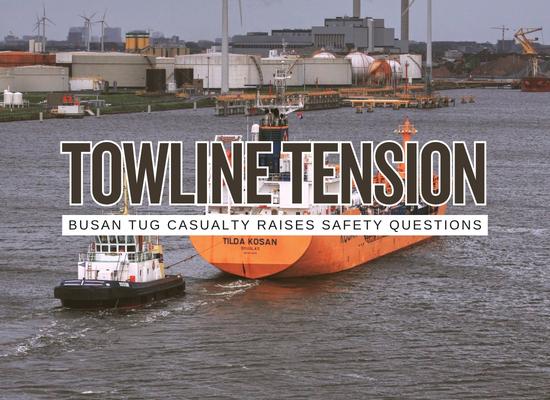
The Busan tug sinking is still under investigation, but the early facts point every operator back to the same high-consequence zone: towline force, turn timing, line angle, quick release, crew escape and whether the tug can recover before the casualty becomes unrecoverable.
286T
Reported size of the TNS Catcher tugboat.
8
Crew members aboard during the capsize.
87m
Approximate depth where the sunken tug was located.
66K+
Tonnage of the Liberia-flagged commercial vessel involved in the assist operation.
Fast read
The confirmed casualty facts are tragic. The operational lesson is narrow and urgent: any tug working under line tension during a course change needs a clear escape path from developing girting, excessive heel or towline overload.
Research notes
Korean and maritime trade reports say the TNS Catcher capsized near Oryukdo while assisting a large Liberia-flagged vessel, then sank later in deep water. Initial investigation reporting says authorities are examining towline force, vessel speed and maneuver timing, while emphasizing that the precise cause has not been established. Recent MAIB tug cases also keep towline release, girting prevention, towline overload and fast crew escape at the center of tug safety discussions.
Sources: Yonhap accident report, Korea Herald accident details, Seoul Economic Daily investigation update, Splash towline tension coverage, MAIB Biter safety lessons, MAIB Svitzer Avon towline failure.
Sources: Yonhap accident report, Korea Herald accident details, Seoul Economic Daily investigation update, Splash towline tension coverage, MAIB Biter safety lessons, MAIB Svitzer Avon towline failure.
Known facts and unresolved questions
| Item | Reported fact | Operator relevance | Status |
|---|---|---|---|
| Vessel | 286-ton tug TNS Catcher. | Small workboats can face very large forces when assisting major commercial ships. | Reported |
| Operation | Assisting a large Liberia-flagged vessel with other tugs. | Multi-tug coordination and command timing become critical. | Reported |
| Motion | Reports say the tug began turning to starboard before rolling to port. | Course change under towline load is a key investigation lane. | Under review |
| Towline | Investigators are examining whether towline tension contributed. | Line angle, quick release and line-load awareness deserve immediate fleet review. | Not confirmed |
| Search | Recovery work was complicated by weather, sea state and poor visibility. | Crew escape, hatch discipline and survival equipment matter when capsize is rapid. | Ongoing in reports |
Operational chain to audit
Assist setup Tug position, line lead, pilot instruction, ship speed and other tug positions need to be understood by everyone involved.
Course change Turning under towline load can shift the tug from useful pull to dangerous heel faster than a crew expects.
Release decision Quick release only helps if it is accessible, maintained, practiced and triggered before the tug passes the point of recovery.
Survival window Watertight integrity, closed doors, escape routes and lifejacket habits matter because some tug capsizes leave very little time.
Six immediate checks for tug operators
01Towline angle limits
Set clear danger-zone language for line angle, ship speed, turn timing and when to abort the maneuver.
02Quick-release proof
Confirm release gear works under realistic load assumptions and crews practice who activates it.
03Line-load awareness
Add tension monitoring, bridge displays or simple operational triggers where the fleet lacks real-time feedback.
04Multi-tug command discipline
Review pilot, tug master and ship bridge communications for simultaneous changes in speed, heading and tow force.
05Watertight habit
Doors and hatches should not be left to convenience during towing. A rapid heel can remove the chance to fix it later.
06Post-incident data capture
Preserve AIS, VDR, CCTV, engine data, winch data and crew statements before the operating picture goes cold.
Commercial angle
This kind of casualty affects more than safety manuals. It can reshape customer confidence, pilot requirements, insurance questions, winch specifications, towline purchases, crew training budgets and contract risk language for high-consequence harbor assist.
Specification items this story pushes forward
| Spec item | Decision-maker question | Useful upgrade |
|---|---|---|
| Winch and release | Can the tow be released fast enough under the worst credible line angle? | Certified quick release, routine loaded testing, bridge access, maintenance records. |
| Line-load data | Does the master see the load building before the tug is in danger? | Tension display, alarms, event logs, training tied to actual force data. |
| Training | Do crews practice girting, capsize, snapback and emergency release as live decision scenarios? | Simulator drills, tabletop cases, recurring onboard drills, pilot debriefs. |
| Hull and tow point | Is the tug being used inside the operating envelope of its design? | Clear tow-point guidance, gob/gog gear where applicable, escort limits, operating matrix. |
| Crew survival | Can crew escape after rapid heel, flooding or inversion? | Closed-hatch policy, escape lighting, muster habits, flotation access, capsize drills. |
Towline capsize pressure checker
Use this quick internal screen after a serious tug incident to decide which operating lane needs the first audit.
This is the main girting and excessive-heel pressure lane.
The window to release can be short once heel develops.
Better data gives the master an earlier warning.
Rapid capsize leaves little time for correction.
Many assist jobs fail at the seam between vessels, not inside one wheelhouse.
Pressure score
110
Higher scores point to more urgent towage safety review.
Review tier
High
Open a focused towline-force and quick-release review before the next high-consequence assist.
First audit lane
Towline angle
Start with the weakest selected lane, then work outward to training and equipment.
Investigation note
This report does not assign fault or claim a final cause. The value for operators is the audit trigger: course changes under line tension, rapid heel, release timing and crew escape are too important to wait for the final report.