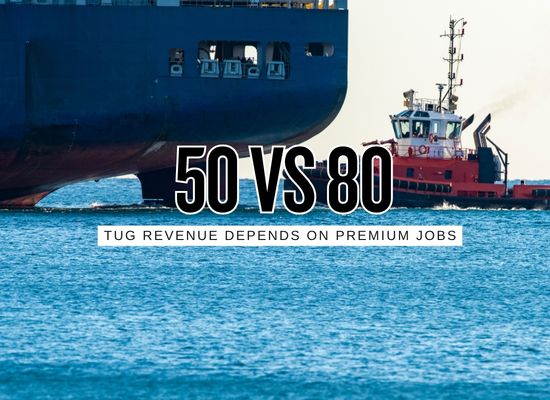
The bigger tug has to earn its extra power twice
I would never judge an 80-tonne tug against a 50-tonne tug by horsepower alone. The bigger tug has to prove that its extra pull can produce higher tariff revenue, unlock larger ship work, win escort or terminal contracts, and still cover the larger capital, fuel, maintenance, winch, rope, insurance, and financing bill.
A 50-tonne tug can be an excellent money-maker in protected harbor work. The 80-tonne tug becomes the better asset only when the port, customers, tariff, tender language, pilot requirements, weather exposure, vessel size, or escort market pays for the extra capability.
An 80-tonne tug has 60% more rated static bollard pull than a 50-tonne tug.
Some public tariff language treats high bollard pull as a separate charging trigger when a tug at or above this level is requested or required.
Published escort-tug tariff language in Canada uses 80 tonnes as the minimum threshold for one high-capability escort category.
One propulsion selection example shows an 80-tonne tug configuration needing materially more total power than a 50-tonne configuration.
Sources: 46 CFR bollard pull definition, 46 CFR 140.805 towing safety, MPA Singapore tug classifications, Pacific Workboats tariff rates, McAllister Baltimore tariff, KOTUG Canada towage tariffs, Cheoy Lee RAmparts 2500-CL, Damen ASD Tug 3212.
The revenue gate is not the same in every port
In one port, an 80-tonne tug might earn more because the tariff applies a high-bollard-pull surcharge. In another, it may earn more because it qualifies for LNG, tanker, escort, or large container work that the 50-tonne tug cannot credibly bid. In a third, the bigger tug may not earn much more at all because the port still requires the same number of tugs and customers refuse to pay a premium.
That is the heart of the decision. The 80-tonne tug is not just a stronger 50-tonne tug. It is a different commercial position. The operator is buying access to heavier moves, stronger safety margin, better tender eligibility, and sometimes a premium rate. The operator is also buying higher capital exposure and a larger operating cost base.
Revenue thesis before ordering the 80-tonne tug
| Decision area | 50-tonne tug advantage | 80-tonne tug advantage | Revenue test | Cost trap |
|---|---|---|---|---|
| Harbor assist | Lower capital and operating burden for routine work. | More authority with larger ships, windage, current, and pilot corrections. | Can the higher-BP tug charge more for the same move? | Buying extra pull when the tariff pays the same rate. |
| Large ships | Useful for smaller vessels and protected berths. | Better eligibility for larger commercial ships and high-windage vessels. | Does the port’s vessel mix create enough additional moves? | Assuming larger ships will automatically switch to the operator. |
| Escort work | Limited unless the port’s escort profile is light. | Stronger candidate for tanker, energy-terminal, and weather-driven escort work. | Does the customer require a minimum BP or escort-rated tug? | Ignoring winch, hull, skeg, crew, and indirect-force requirements. |
| Fuel burn | Lower average burn when jobs are simple. | Can be efficient if the bigger tug replaces weak assets or prevents delays. | Does premium revenue cover extra gallons or energy? | Modeling fuel at best-case load instead of actual job profile. |
| CAPEX | Lower financing cost, lower insurance value, lower depreciation burden. | Higher residual value if the market wants high-BP tugs. | Does incremental annual contribution beat the capital charge? | Counting gross revenue instead of contribution after fuel and maintenance. |
8 ways the 80-tonne tug can actually earn more
Higher tariff category
The cleanest revenue case is a published rate or contract term that pays more for high bollard pull. If the local tariff rewards the bigger tug, the owner can model premium hours directly rather than relying on a vague marketing claim.
Large ship eligibility
An 80-tonne tug can help an operator move into ship classes where the 50-tonne tug is not preferred, not permitted, or not competitive. That can mean larger container vessels, bulk carriers, tankers, cruise ships, car carriers, or high-windage ships.
Escort contract access
Escort work can change the economics because it is often tied to higher consequence, stricter procedures, and longer service windows. A public escort tariff with an 80-tonne category is a reminder that bollard pull can be a qualification gate, not just a spec sheet number.
Fewer lost weather windows
Bigger pull can protect revenue by keeping moves viable in wind, current, swell, or tight channels. The gain may not show as a higher invoice line. It may show as fewer cancellations, fewer delays, less standby, and fewer chartered backup calls.
Less outside tug hire
An operator using outside high-BP assistance for specific vessels may be leaking margin. The 80-tonne tug can recapture those jobs, reduce subcontractor dependence, and keep customer relationships inside the fleet.
Long-term terminal confidence
Ports, LNG developers, refineries, tanker terminals, and industrial customers may pay for capability even when daily utilization looks uneven. A higher-BP tug can be part of a standby and reliability package that supports a multi-year service contract.
Higher residual and charter appeal
A stronger tug may have broader resale or charter appeal in ports that are upgrading fleets for larger vessels and high-consequence terminals. That matters when calculating lifetime economics, not just the first-year revenue.
Sharper customer positioning
Sometimes the bigger tug does not win because it is used every hour. It wins because the fleet can say yes to more complicated jobs. That can shift the operator from commodity harbor assist toward premium towage, energy terminal support, or high-reliability service.
The real break-even question
The bigger tug only wins if incremental contribution beats incremental cost. That means revenue after fuel, crew differences, maintenance, insurance, capital charge, rope and winch wear, and downtime, not just extra invoice value.
50-tonne asset profile
Best earning lane
Protected harbor Routine assist Lower capitalThe 50-tonne tug can be the better business when job volume is steady, vessels are moderate, rates are fixed, and the port does not pay a meaningful premium for extra bollard pull.
Revenue ceiling
Tender limits Large ship gaps Backup hireThe ceiling appears when the tug is excluded from bigger moves, needs help from outside tugs, or cannot satisfy the customer’s safety margin.
80-tonne asset profile
Best earning lane
High BP tariff Escort work Terminal contractsThe 80-tonne tug is strongest when the market pays for capability through higher rates, larger moves, committed standby, or contract eligibility.
Cost ceiling
Fuel burn Capital charge Lifecycle costThe cost ceiling appears when the tug spends too many hours doing ordinary work at ordinary rates while carrying premium machinery cost.
| Model item | 50-tonne default logic | 80-tonne default logic | Operator input that matters most |
|---|---|---|---|
| CAPEX | Lower asset price and lower financing burden. | Higher asset price, stronger machinery, larger gear, more capital at risk. | Incremental capital cost and required return on capital. |
| Fuel burn | Lower average burn for routine moves. | Higher burn unless the bigger tug shortens moves or avoids support tugs. | Average gallons per hour on actual job profile. |
| Rate premium | Often standard harbor rate. | Possible high-BP surcharge, premium hourly rate, or contract uplift. | Real tariff language and customer willingness to pay. |
| Utilization | Can run high utilization in routine work. | Needs enough premium or unlocked hours to cover higher cost. | Incremental premium hours per year. |
| Escort revenue | Limited in tougher escort profiles. | Can become a qualification asset for tanker, LNG, and weather matrix work. | Annual standby, escort, or terminal commitment value. |
50 vs 80 bollard pull revenue calculator
Use this model to test whether the 80-tonne tug earns enough incremental contribution to justify higher capital, fuel, maintenance, and insurance cost.