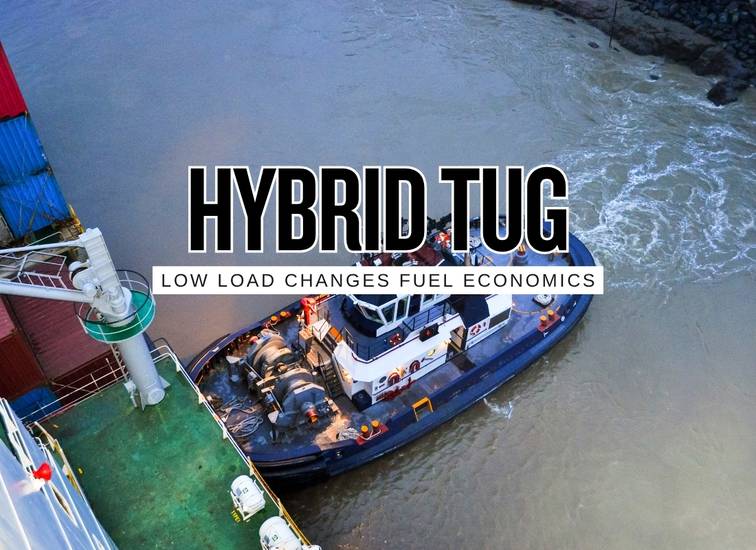
Low load is the business case
Hybrid tug economics start with a simple operating truth: the vessel is not pulling at full bollard power most of the day. It waits, transits, assists, surges, and waits again. That uneven cycle is the reason a harbor tug can benefit from hybrid propulsion differently than a cargo ship on a long steady voyage.
Typical share of time peak power may be needed for harbor-assist and escort tugs in MARAD guidance.
Reported share of time Harbor Docking hybrid tugs operated without main engines in prior Lake Charles service coverage.
Bollard pull ahead listed for Harbor Docking & Towing’s new RApport 2800-H hybrid docking tug design.
Electric motor rating per side on the new RApport 2800-H design.
Sources: Robert Allan RApport 2800-H, Caterpillar hybrid Q&A, Louisiana Cat hybrid propulsion, Professional Mariner Harbor Docking hybrid coverage.
The tug cycle that changes the math
Tug economics compared with cargo ship economics
| Factor | Harbor tug | Cargo ship | Hybrid implication |
|---|---|---|---|
| Load profile | Short bursts, standby, low-speed transit, repeated mode changes. | Longer periods at steadier propulsion load. | Tug batteries and generators can target low-load waste and quick response. |
| Power sizing | Engines sized for rare hard pulls. | Main engine sized for voyage service profile. | Tugs can carry large engines but avoid running them all day. |
| Savings source | Reduced main-engine hours, better genset loading, fast torque support. | Voyage optimization, auxiliary load management, hotel loads, port operations. | Tug savings are highly sensitive to the daily dispatch pattern. |
| Commercial test | Fuel, maintenance, emissions, responsiveness, terminal credibility. | Fuel per voyage, CII/EEXI strategy, cargo schedule and charter economics. | A tug hybrid must be priced against jobs per day, not only miles sailed. |
Six places hybrid propulsion can pay
Standby without main engines
The largest opportunity is often the quietest part of the day. Shutting down big mains during waiting or position holding can reduce fuel burn and engine hours.
Transit on smaller machinery
Low-speed movement to and from jobs can be handled by electric motors supplied by smaller generators or batteries, depending on the system.
Peak power only when needed
The Harbor Docking design keeps full-power capability by combining diesel engines and electric motors in hybrid mode during heavy maneuvers.
Lower engine wear
Caterpillar says hybrid systems can let diesel engines operate closer to optimal load instead of spending extended time at low load.
Better throttle response
Electric torque can help during quick transitions from waiting to assist, which matters in tight channels and terminal work.
More credible emissions story
Hybrid tug economics improve when customers, ports or terminals value lower emissions near the waterfront.
The clean decision rule
A hybrid tug makes the strongest case when more than half of the working day is standby, loitering, low-speed transit or partial-load maneuvering, and the owner can turn reduced main-engine hours into measurable fuel, maintenance or emissions value.
Hybrid tug fuel savings estimator
Use this quick model to test whether the low-load hours are large enough to justify a hybrid system.