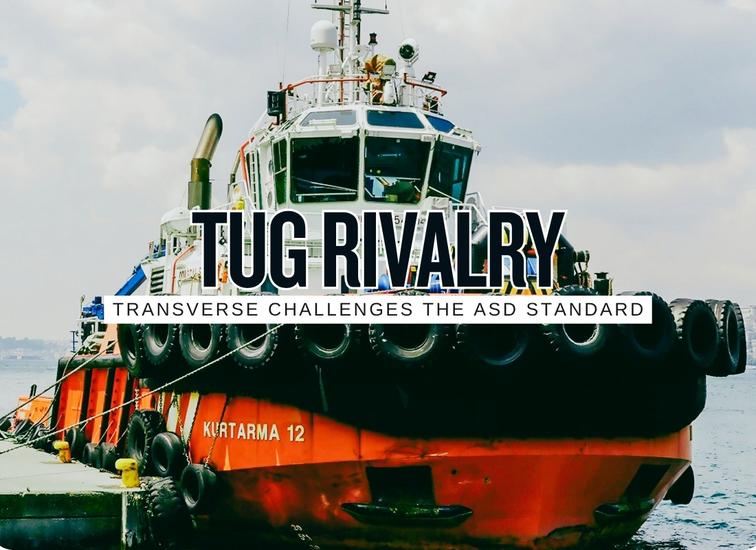
The challenge to ASD is no longer theoretical
Six more TRA2900 orders take Cheoy Lee’s Svitzer program to 14 vessels. The real question is not whether the TRAnsverse can match an ASD’s bollard pull. It is whether ports will pay for the extra steering, braking and positioning capability once the ship is moving.
TRA2900 units now ordered from Cheoy Lee.
Bollard pull specified for the new 29-metre vessels.
Svitzer’s claimed increase in dynamic operating envelope above roughly 2-3 knots.
Commercial jobs already accumulated by operating TRAnsverse tugs.
The comparison
| Decision point | TRAnsverse 2900 | Modern ASD reference | Buyer read |
|---|---|---|---|
| Length | 29 m | Damen ASD 2813: 27.6 m | Comparable harbor footprint. |
| Bollard pull | 80 t | ASD 2813: 82.7 t ahead | Static pull alone does not separate them. |
| Tow geometry | Patented half-circle staple, double-ended hull and inline propulsion. | Conventional twin azimuth stern-drive architecture. | The biggest design difference appears once the tug is moving. |
| Side movement | Up to about 8 knots sidestepping reported for TRA2900. | ASD designs are highly maneuverable but generally reposition by vectoring stern drives. | TRAnsverse aims to spend less time repositioning between force directions. |
| Dynamic force | Svitzer reports materially higher steering and braking forces at speed. | High-performance escort ASDs can also generate substantial hydrodynamic forces. | Port-specific escort curves matter more than bollard pull. |
| Fuel | Svitzer reports gains of up to 15% in its testing and operating work. | Depends heavily on ASD design, duty cycle and operating technique. | Demand measured job-by-job fuel data before paying a premium. |
| Procurement | Proprietary Svitzer design and operating concept. | Large global supplier, yard, equipment and crew ecosystem. | ASD keeps the advantage in standardization and sourcing flexibility. |
The dynamic-force gap is the real story
Those figures are for the 32-metre TRAnsverse 3200, not the new TRA2900. They show the concept behind the design: use hull-generated hydrodynamic force as well as propulsion instead of judging tug capability only by static bollard pull.
TRAnsverse has the stronger case when
Escort forces matter, the assisted ship remains underway, pilots need rapid transitions between pull and push, the port is tight, or one tug must cover several different towing positions efficiently.
ASD still has the stronger case when
The work is conventional harbor assist, crews already know the platform, fleet commonality matters, rapid replacement is valuable, or the owner wants competitive procurement across several builders and equipment packages.
Five questions port buyers should ask
If most jobs are slow ship-assist, an 80-tonne ASD may already deliver everything required.
Value rises if faster positioning, sidestepping or broader working positions reduce delays or tug requirements.
TRAnsverse looks strongest where rapid shifts between direct, indirect, push and pull modes are common.
ASD fleets have a deep global pool of masters, yards, spares, service vendors and proven operating procedures.
Ask for actual fuel per job, maneuver time, steering force curves and pilot feedback in the intended port profile.
TRAnsverse vs ASD port-fit screen
Score the work profile, not the marketing brochure.