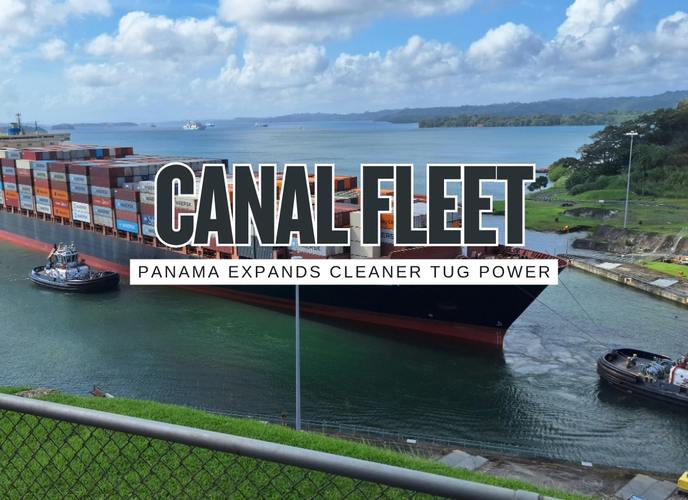
Panama is turning tug renewal into operating strategy
The Panama Canal’s hybrid tug program gives other port authorities a rare large-scale example of cleaner towage tied directly to high-frequency vessel movements. The order is not just about buying greener tugs. It is about protecting maneuvering reliability, reducing fuel burn, lowering emissions, supporting maintenance efficiency, and keeping tug capacity aligned with the daily pressure of one of the world’s most demanding transit corridors.
Operator Impact Snapshot
Hybrid tugs are now part of the expanded Panama Canal program after the additional order.
Reported bollard pull per tug, aimed at daily Canal maneuvering needs.
Battery capacity cited for the Isla Barro Colorado hybrid tug in Canal materials.
New hybrid tugs were recently celebrated as additions to the Canal’s operational fleet.
Estimated annual generation from a Canal photovoltaic project that supports the wider energy strategy.
Sources: Baird Maritime additional tug order, Panama Canal five hybrid tugs, Panama Canal Isla Barro Colorado, Panama Canal sustainability program, Baird vessel review.
The Canal model begins with duty cycle
The Panama Canal is a special operating environment because tug work is frequent, structured, safety-critical, and linked to the reliability of a global trade corridor. That makes hybrid propulsion more than a fuel-saving experiment. A hybrid tug can use battery support for lower-load work, peak power management, emissions reduction, and machinery-life benefits while still retaining diesel power for demanding maneuvers.
Other port authorities should not copy the order size first. They should copy the method: study the daily tug cycle, identify where diesel engines are wasting energy, confirm where battery support changes the operating profile, and then match procurement to the work rather than the public-relations message.
| Planning area | Panama signal | Port authority lesson | Procurement check |
|---|---|---|---|
| Fleet scale | Expanded toward a 20-tug hybrid program. | Large orders make sense only when the duty cycle is well understood. | Start with utilization data before setting order quantity. |
| Power profile | 80-ton bollard pull with diesel-electric battery support. | Cleaner propulsion still needs full maneuvering capability. | Compare peak pull, sustained work, battery use, and recovery time. |
| Reliability | Hybrid propulsion is linked to maneuver dependability. | Environmental goals should not weaken port throughput. | Require redundancy, service support, and training plans. |
| Maintenance | Canal materials connect hybrid systems with lower maintenance cost and longer equipment life. | Total ownership cost should matter more than purchase price alone. | Request engine-hour, maintenance-interval, and lifecycle modeling. |
| Sustainability | Hybrid tugs sit inside a wider clean-energy and low-carbon strategy. | Tugs should be part of the port energy plan, not a separate green project. | Connect tugs, shore power, renewable power, fuel trials, and reporting. |
Hybrid procurement sequence for port authorities
8 lessons for other port authorities
Start with the working day, not the technology label
Hybrid tugs are strongest when the port understands exactly how its tugs work. A port with repeated vessel assists, frequent low-load running, predictable standby periods, and high daily utilization can make a stronger case than a port buying hybrid because it sounds modern.
Hybrid only works if the tug still has real muscle
Panama’s program does not appear to trade capability for sustainability. The reported 80-ton bollard pull figure keeps the vessels in serious harbor-work territory. That is the right framing for port authorities: cleaner tugs still have to move the ships safely.
Series orders need a learning curve plan
A 20-vessel program is not a one-off demonstration. It requires delivery rhythm, crew familiarization, spare parts, battery service, software updates, inspection routines, and feedback loops from the first units into later units.
Maintenance savings need proof, not hope
Hybrid systems can reduce inefficient diesel running and potentially reduce wear on some components, but port authorities should ask vendors to model the maintenance case clearly. Battery systems, controls, cooling, software, and power electronics also require maintenance support.
Cleaner tugs should be tied to the port energy strategy
The Canal’s hybrid tug program sits alongside renewable power, low-carbon fuel testing, green maritime corridors, and sustainability reporting. That is a stronger model than treating tugs as a stand-alone procurement story.
Crew acceptance can decide the real outcome
Hybrid tug performance depends on crews understanding the energy system, alarms, battery modes, diesel-electric transitions, emergency procedures, and maintenance boundaries. A sophisticated system can fail commercially if it creates confusion during tight maneuvers.
Firefighting and emergency value still matter
The reported FiFi1 firefighting capability is an important reminder that hybrid procurement should not become too narrow. A port tug is also part of the harbor’s emergency-response network, especially in dense vessel traffic, locks, terminals, and industrial waterfronts.
A big order can reduce charter dependence
Industry coverage of the Isla Barro Colorado series notes that the hybrid tug introduction can help reduce reliance on chartered tugs while improving efficiency and sustainability. For port authorities, that is one of the strongest commercial angles: owning the right fleet can reduce operational uncertainty.
The strongest takeaway
Panama’s hybrid tug program is useful because it joins sustainability with everyday port performance. The lesson for other authorities is not to buy the same tug. It is to buy around the same discipline: duty cycle, capability, maintenance, energy strategy, crew readiness, and lifecycle cost.
Port profiles that fit hybrid tugs best
High-utilization transit corridors
Strong fit Repeat cycles Reliability pressurePorts and canals with frequent, structured vessel movements can create a strong hybrid case because the operating cycle is easier to model and the fuel savings can repeat every day.
Industrial ports with standby demand
Good fit Low-load reduction Emergency coverageHybrid can help when tugs spend meaningful time waiting, repositioning, or running at low load while still needing full diesel capability during intense maneuvers.
Clean-air waterfronts
Strong public case Community pressure Grant potentialHybrid tugs can support cleaner air goals in ports close to neighborhoods, cruise terminals, waterfront developments, and high-visibility public corridors.
Low-volume ports with varied assignments
Careful review Mixed economics Pilot firstA full hybrid series may be harder to justify when tug work is infrequent, widely varied, or more dependent on long-range and emergency assignments.
Hybrid tug authority fit calculator
This tool estimates whether a port authority has the operating profile to justify a Panama-style hybrid tug program. It is a planning tool, not a procurement approval model.
Hybrid program fit bar
Fit appears early. Gather operating data before committing to a major hybrid procurement.