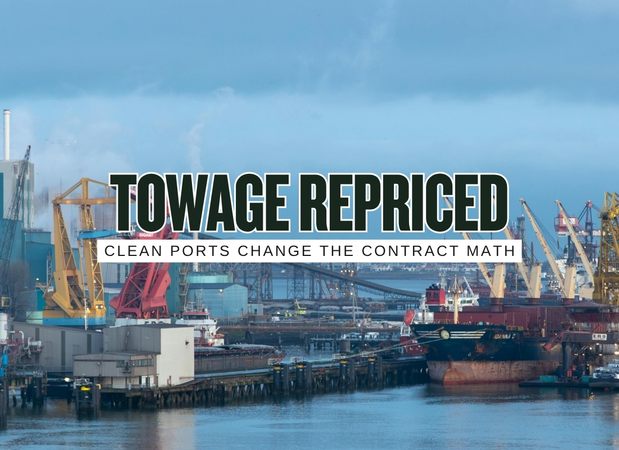
Port decarbonization is starting to change the commercial math behind harbor tug services. The old day-rate model is simple, familiar, and easy to invoice, but it does not always fit a fleet that now carries battery packs, hybrid systems, renewable diesel exposure, charging windows, emissions reporting, grant compliance, new crew training, and uptime guarantees. That gap is getting more visible as ports move from general clean-air goals into actual vessel and infrastructure programs. The EPA’s Clean Ports Program is funding nearly $3 billion in zero-emission port equipment, infrastructure, and planning across 26 states and territories, while California’s commercial harbor craft rules and port programs continue to push cleaner harbor vessels into real service. Recent projects also show towage customers moving toward long-term service contracts tied to lower-emission tug fleets, including a 20-year services contract connected to four advanced hybrid escort tugs for Woodside Louisiana LNG. For tug owners, the pricing question is no longer just daily vessel availability. It is also fuel risk, emissions value, infrastructure responsibility, performance proof, and who pays when a cleaner operating model changes the workday.
The tug invoice is about to carry more than vessel time
As ports push cleaner harbor craft, tug contracts may need to pay for emissions performance, energy infrastructure, charging windows, low-carbon fuel exposure, verified data, and guaranteed response. The day rate can still exist, but it may no longer be enough to price the full operating risk.
Nearly awarded under the U.S. Clean Ports Program for zero-emission equipment, infrastructure, and planning.
Recent LNG terminal towage service contract tied to advanced hybrid escort tugs in Louisiana.
Zero-emission ship assist tugboats included in a 2026 South Coast AQMD contract action.
Modeled emissions reduction from electric tugboat introduction in one container-port electrification study.
Contract tension
A traditional day rate pays for a tug being available. A decarbonized port may need a contract that also pays for cleaner energy, charging infrastructure, verified emissions data, crew retraining, uptime guarantees, battery degradation, renewable diesel or alternative-fuel exposure, and the commercial value of helping the terminal or port meet its own targets.
The old day rate is simple, but the cost stack is changing
Towage has always included hidden complexity. Dispatch reliability, crew availability, engine maintenance, weather exposure, standby coverage, peak vessel calls, and emergency response have never been simple. Decarbonization adds another layer. A hybrid escort tug, battery-electric harbor tug, renewable diesel fleet, or methanol-ready newbuild can carry a different capital cost, energy-cost structure, maintenance profile, reporting obligation, and infrastructure dependency than a conventional diesel tug.
The result is a pricing problem. If the contract pays only for time, the tug owner may absorb costs that were created by the port’s emissions strategy. If the contract pays only for clean performance, the customer may fear unpredictable invoices. The next generation of towage contracts will likely blend familiar availability pricing with new clauses that allocate fuel risk, energy infrastructure, emissions proof, and performance bonuses more clearly.
Old day-rate friction points in a cleaner port
| Friction point | Old contract treatment | Decarbonized fleet complication | Better contract response |
|---|---|---|---|
| Fuel exposure | Fuel may be embedded, passed through, or adjusted with a basic surcharge. | Renewable diesel, shore electricity, methanol, hydrogen, or hybrid fuel mixes can move differently than diesel. | Separate energy index, transparent pass-through, or shared savings formula. |
| Charging time | Standby and downtime are usually treated through availability language. | Electric tugs may need scheduled charging windows that must be coordinated with berth demand. | Protected charging blocks, dispatch rules, and downtime responsibility clauses. |
| Capex recovery | The day rate recovers vessel ownership and operating cost over time. | Cleaner tugs can have higher upfront capital costs and specialized infrastructure costs. | Availability retainer, green fleet premium, or long-term capacity reservation. |
| Emissions value | Cleaner operation may not be separately priced. | Ports and terminals may gain regulatory, ESG, grant, community, or customer value from lower emissions. | Verified emissions credit, performance bonus, or clean-service premium. |
| Data burden | Operational reporting may be limited to vessel calls, hours, and invoices. | Cleaner contracts may require energy, emissions, fuel, engine tier, charger use, and uptime reporting. | Data fee, reporting standards, audit rights, and shared dashboard access. |
9 pricing models that could replace the old day rate
① Availability retainer plus activity fee
The customer pays a fixed monthly or annual retainer for guaranteed tug capacity, then adds a smaller fee for each movement, assist hour, or job category. This protects the operator’s capital recovery while giving the terminal or port predictable access to cleaner assets.
② Emissions-indexed service rate
The towage price includes a base rate plus an adjustment tied to verified emissions performance. If the tug operator delivers cleaner service than the contract baseline, the rate improves. If emissions exceed the target, the premium falls or a credit is applied.
③ Clean-fleet premium with open-book cost review
The customer pays a visible premium for lower-emission tug service, while the operator provides an agreed level of cost transparency. This model is useful when a customer wants cleaner towage but does not want every invoice to fluctuate with fuel or energy markets.
④ Energy pass-through with efficiency sharing
The customer pays the actual cost of approved energy sources, such as electricity, renewable diesel, or alternative fuel, while both sides share savings from efficiency improvements. This prevents the tug owner from being punished for volatile energy costs while still encouraging better operations.
⑤ Charging-window protected tariff
The tug operator receives rate protection when the port or terminal requires cleaner electric service but also controls berth access, charger access, vessel scheduling, or grid availability. If charging access is delayed by customer-side constraints, the contract treats that time differently from operator downtime.
⑥ Performance band pricing
Rates move within agreed bands based on operational performance. The band can include response time, job completion, tug availability, emissions performance, fuel consumption, safety performance, and reporting quality. Instead of one flat day rate, the operator earns more for consistently meeting the service profile the port actually values.
⑦ Carbon-inset towage rate
The customer pays a premium for cleaner tug service and counts the verified reduction within its own logistics or port-call decarbonization program. This is not a generic offset purchased elsewhere. It is a reduction connected to the actual port service being used.
⑧ Infrastructure co-investment credit
The port, terminal, or anchor customer helps fund chargers, berth upgrades, substations, or alternative-fuel systems. The operator then gives a contract credit, lower long-term rate, or capacity commitment in return. This model can unlock projects that are hard for the tug owner to finance alone.
⑨ Long-term green capacity contract
The customer signs a long-term services agreement that supports the construction or conversion of a cleaner tug fleet. The tug owner receives contract certainty, while the customer receives dedicated capacity, cleaner service, and a stronger claim that its port operations are moving toward lower emissions.
Contract model scorecard
| Pricing model | Predictability for customer | Protection for tug owner | Decarbonization fit | Potential weak spot |
|---|---|---|---|---|
| Availability retainer plus activity fee | High | High | Strong for dedicated clean fleets | Can feel expensive during low traffic periods |
| Emissions-indexed service rate | Medium | Medium | Strong for measurable reductions | Requires trusted data and baseline agreement |
| Clean-fleet premium | High | Medium | Good for early adoption | May be challenged if premium is not well explained |
| Energy pass-through with sharing | Medium | High | Good for energy volatility | Savings disputes if baseline is weak |
| Charging-window protected tariff | Medium | High | Strong for electric tug deployment | Needs clear responsibility for charger delays |
| Performance band pricing | Medium | Medium | Flexible across technologies | Bad incentives if metrics are poorly weighted |
| Carbon-inset towage rate | Medium | Medium | Strong for customers with reporting goals | Claims must be carefully documented |
| Infrastructure co-investment credit | High over long term | High if structured well | Strong when chargers or substations are bottlenecks | Asset ownership and access can become contentious |
| Long-term green capacity contract | High | Very high | Strong for newbuild or conversion commitments | Technology may change before contract ends |
Towage pricing model selector
This tool suggests a contract direction based on fleet technology, traffic predictability, infrastructure control, and emissions-reporting pressure. It is designed as a planning guide, not a legal or financial model.
Clauses that need sharper language
Practical transition path for ports and operators
The cleanest transition may not be a sudden replacement of every day rate. A more realistic path is a layered contract. The base agreement can keep a familiar availability or job-rate structure, while addenda handle energy cost, charging windows, emissions data, incentives, and infrastructure access. That lets ports and tug operators modernize pricing without making every invoice feel experimental.
The first negotiations will likely be uneven. Operators will worry about paying for new technology without long-term customer commitments. Ports and terminals will worry about paying a premium without proof of performance. The best contracts will bridge that gap with clear baselines, shared data, defined responsibility, and pricing that rewards real performance instead of vague green language.