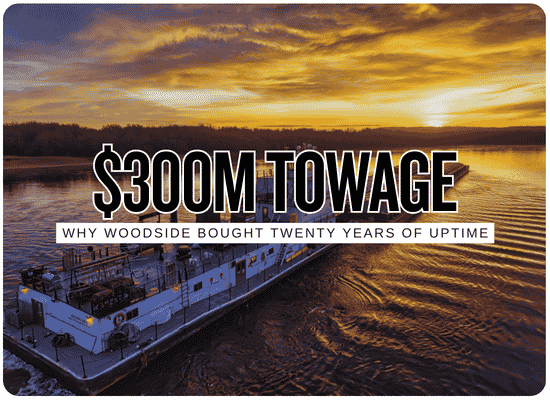
The $300 Million Tug Contract
Woodside needs four new hybrid escort tugs for Louisiana LNG. But it did not simply buy four boats. It signed a 20-year services agreement worth more than $300 million. The difference explains where the real value in modern LNG towage lies: guaranteed availability, trained crews, maintenance, redundancy, emergency response and the ability to move LNG carriers when the terminal needs them moved.
Four tugboats do not explain a $300 million contract. Crews do. Maintenance does. Twenty-four-hour readiness does. Keeping a replacement tug available when another vessel is in the yard does. So do emergency response, dispatch, training, insurance, shoreside support and twenty years of knowing that an LNG carrier arriving at a multibillion-dollar terminal will have the marine assistance it needs. That is the interesting part of Woodside’s Louisiana LNG deal. The tugboats are the hardware. What Woodside is really buying is availability.
Woodside didn’t order four tugs. It outsourced a marine operation for 20 years.
Woodside Energy awarded Green Tug Towing, a joint venture between Saltchuk Marine and Harbor Docking & Towing, a long-term services contract to support vessel traffic at the Louisiana LNG terminal in Calcasieu Parish.
Spread evenly over twenty years, a $300 million contract represents a minimum equivalent of $15 million per year. That does not mean Green Tug Towing receives exactly $15 million every year, and it does not reveal the contract’s payment structure. It simply shows why dividing $300 million by four and calling these “$75 million tugboats” would be wrong. Most of the agreement concerns decades of service after construction is finished.
Asset purchase versus managed service
If Woodside merely purchased four tugs, it would still need an organization to crew them, maintain them, dispatch them, insure them, manage regulatory compliance, operate the shore facility and provide coverage when one vessel became unavailable.
Instead, Green Tug Towing is responsible for establishing the operating capability around the vessels themselves.
The real product is a marine service that has to work every time
Green Tug Towing’s announced scope goes considerably beyond putting four hulls alongside LNG carriers. The company will provide a package of marine services supporting the terminal’s vessel movements.
Berthing
Controlled tug assistance as loaded or ballast LNG carriers move from the ship channel into the terminal berth.
Unberthing
Moving a carrier safely away from loading infrastructure and back toward the navigable channel.
Escort
High-performance tug capability available while large LNG carriers transit constrained waterways.
Standby
Vessels and crews need to be ready even when they are not actively pushing or pulling a ship.
Emergency Response
Towage assets become part of the terminal’s marine risk-management capability when something does not go according to plan.
Harbor Assist
The tug fleet can perform additional ship-assist work around the terminal and surrounding marine operation.
The economic value of a dedicated tug is often highest while the tug appears to be doing nothing. Standby capacity is effectively an insurance policy: the terminal is paying for a qualified tug and crew to be available when the vessel movement requires them, rather than hoping capacity can be found on the open harbor market at that moment.
A 20-year towage contract moves an entire category of operating risk away from the terminal
| Operational Requirement | If Woodside Owned The Tugs | Under A Long-Term Service Model |
|---|---|---|
| Tug construction | Terminal owner manages newbuild program directly | GTT manages construction and delivery |
| Crewing | Recruit, train and retain marine personnel | Towage operator supplies marine workforce |
| Maintenance | Terminal carries maintenance organization and planning burden | Operator manages vessel availability and upkeep |
| Dispatch | Terminal manages tug movements itself | Professional tug operator coordinates marine service |
| Regulatory compliance | Marine compliance becomes an internal competency | Experienced vessel operator carries day-to-day responsibility |
| Equipment downtime | Terminal must manage unavailable assets and replacements | Availability becomes part of the contractor relationship |
| Technology obsolescence | Terminal owns vessels as equipment ages | Commercial arrangement can allocate lifecycle obligations contractually |
A stopped tug can become a stopped LNG cargo
Tug reliability matters at every major port, but an export terminal changes the financial consequences. Louisiana LNG is not simply a dock receiving occasional ships. It is being developed as a continuous production-and-export system.
The terminal itself is a $17.5 billion machine.
Woodside’s foundation development consists of three LNG trains with 16.5 million tonnes per annum of capacity and first LNG targeted for 2029. The site is permitted for eventual expansion to 27.6 Mtpa. Its original marine authorization contemplated three LNG berths capable of receiving carriers up to approximately 216,000 cubic metres. At the fully permitted production level, the earlier project plan contemplated loading as frequently as roughly one vessel per day.
LNG trains, pipeline and associated development costs dwarf the tug contract.
Three trains form the first sanctioned stage of Louisiana LNG.
Future expansion could increase marine-service requirements further.
Against a $17.5 billion development, a $300 million-plus twenty-year marine-service commitment represents less than two percent of the initial project cost when the two headline figures are compared directly. Yet those tugs sit at one of the final physical interfaces between the LNG plant and its paying customer: getting a carrier safely alongside the berth and then back to sea.
The terminal doesn’t need four tugboats. It needs four tugboats to be ready.
LNG is produced
Gas moves through liquefaction trains and into large storage tanks awaiting export.
Carrier arrives
The ship must transit the Calcasieu waterway and enter the terminal’s marine area.
Tugs execute
Escort, turning, berthing and departure require capable vessels and crews at the right time.
Cargo leaves
A successfully loaded carrier becomes another shipment in Woodside’s global LNG portfolio.
If tug availability were unreliable, the terminal could not simply treat that as a minor transportation inconvenience. Berth scheduling, storage inventory, ship arrival windows and plant operations are connected. A delayed vessel can create knock-on effects throughout the export chain.
Redundancy may be almost as valuable as horsepower
The contract announcement does not publicly disclose the precise tug-allocation rules for every LNG-carrier movement. But a four-vessel dedicated fleet provides something no single high-powered tug can provide: redundancy.
Maximum capability, minimum redundancy
- A mechanical casualty can remove a large share of available capability.
- Scheduled drydocking creates an immediate replacement requirement.
- Simultaneous marine movements become difficult.
- Crew availability becomes highly concentrated.
Capacity can be distributed
- Maintenance can occur while other vessels remain available.
- Multiple tugs can work one high-consequence movement.
- Standby capacity can coexist with active work.
- Fleet scheduling gains flexibility over a 20-year contract.
LNG terminal tugs have exactly the kind of duty cycle hybrid propulsion likes
The Green Tug Towing vessels will use Robert Allan Ltd.’s RApport 2800H platform with diesel-electric hybrid propulsion. Project partners say the system is intended to reduce fuel consumption and emissions during standby, harbor transit and low-speed maneuvering while preserving the high indirect steering forces and bollard pull needed for LNG-carrier work.
Waiting, repositioning and harbor transit
These periods do not necessarily require the full output of large main engines. A hybrid plant can provide more efficient operating modes during the substantial portion of a tug’s life spent below maximum power.
Escort and ship handling
When a large carrier needs steering force or bollard pull, the propulsion plant must still deliver serious power immediately. Hybridization supplements that capability rather than eliminating it.
Do not confuse these vessels with C&C’s other four-tug series.
C&C Marine currently has eight hybrid escort tugs in its combined construction program: four for Green Tug Towing’s Woodside contract and a separate four-vessel Harbor Docking & Towing program. Detailed horsepower and bollard-pull figures published for the separate Harbor Docking vessels should not automatically be attributed to the Woodside tugs until the final Green Tug Towing specifications are publicly confirmed.
The Woodside contract is also creating a miniature production program in Belle Chasse
C&C Marine and Repair says its active tugboat construction workload now totals eight vessels when the four Green Tug Towing newbuilds are combined with four Harbor Docking & Towing vessels already under construction.
Multi-vessel orders matter to a shipyard because repeat construction creates opportunities to spread engineering effort, tooling, procurement knowledge and worker experience across sister vessels. The eighth tug generally should not require the same learning curve as the first.
Woodside is combining local waterway knowledge with a much larger towing organization
Local operating knowledge
- Lake Charles-based operator.
- Operating in the region since 1955.
- Long experience on the Calcasieu Shipping Channel.
- Existing hybrid-tug operating experience.
Large-scale towing infrastructure
- Marine-services platform with multiple operating companies.
- Ship-assist and tanker-escort expertise.
- Experience across major U.S. ports.
- Operational depth beyond a single terminal.
The joint venture therefore resembles another form of risk management. Woodside is not asking a newly created company to invent the capabilities from scratch: Green Tug Towing combines two established towing organizations and then dedicates that expertise to the terminal.
The $300 million headline becomes more interesting when spread across twenty years
| Simple Illustration | At $300 Million | What It Does — And Does Not — Mean |
|---|---|---|
| Total minimum headline value | >$300 million | The announced contract value floor |
| Annual equivalent | >$15 million/year | Simple division only; actual payments may differ substantially |
| Fleet-day equivalent | >$41,000/day | Illustrates service scale, not a published daily charter rate |
| Per-tug-year equivalent | >$3.75 million | Not revenue actually allocated equally to each vessel |
| Per-tug 20-year equivalent | >$75 million | Absolutely not the purchase price of one tug |
A $300 million contract is only about 1.7% of a $17.5 billion project when the two headline values are compared. That comparison is imperfect because one is a 20-year service contract and the other is development capital, but it makes the strategic logic obvious: the towing commitment is relatively small beside the value of the industrial system whose vessel movements it protects.
Long contracts can make expensive specialized tugs easier to finance
Purpose-built escort tugs require substantial capital before they earn their first dollar. An operator normally has to make that investment while carrying future utilization risk. A twenty-year terminal agreement changes that equation.
Revenue visibility
A long service term provides a clearer commercial basis for committing capital to specialized newbuilds.
Purpose-built equipment
Vessels can be optimized around the specific terminal rather than purchased for speculative general harbor work.
Training investment
Longer customer relationships can justify deeper investment in crews, simulators, procedures and terminal-specific knowledge.
Maintenance planning
Lifecycle overhaul schedules can be designed around a known long-term service obligation.
Shore infrastructure
Green Tug Towing can justify operating a dedicated Lake Charles facility because the work extends far beyond a short charter.
Residual opportunity
At contract end, the operator may still own vessels and expertise with continuing commercial value, depending on future arrangements and asset condition.
The next major tug customer may look more like an infrastructure developer than a port
Louisiana LNG illustrates a model that becomes increasingly attractive wherever maritime terminals require specialized, reliable vessel-assist capacity for decades. LNG is especially suited to it, but the logic can extend to large container terminals, crude-export terminals, petrochemical facilities and other high-throughput marine infrastructure.
Watch whether future U.S. LNG developments package tug capacity into long-term services agreements instead of relying primarily on ordinary harbor dispatch.
Twenty-year commitments can fundamentally change how tug operators evaluate newbuild financing and technology.
Lower-emission tug technology may increasingly move from an operator preference into terminal procurement specifications.
The business shifts from selling individual tug jobs toward managing a permanent marine-service function.
Louisiana LNG’s permitted capacity exceeds the initial 16.5 Mtpa development. Future trains could increase vessel traffic and eventually alter towage requirements.
The GTT vessels’ detailed machinery, bollard pull and equipment packages will reveal exactly how the terminal’s risk analysis translated into hardware.
Research base
Research for this report included Woodside Energy’s Louisiana LNG project releases and investment materials; Green Tug Towing and Saltchuk Marine announcements; Harbor Docking & Towing materials; C&C Marine and Repair project information; WorkBoat and MarineLink coverage; Robert Allan Ltd. design information; and federal LNG-terminal authorization documents describing Louisiana LNG’s marine facilities. Information reviewed through October 13, 2026.
What does a long-term tug contract look like when annualized?
Adjust contract value, duration and fleet size to see the simple annual and per-vessel equivalents. This tool deliberately does not estimate profit or vessel purchase price because the contract covers a much broader service operation.