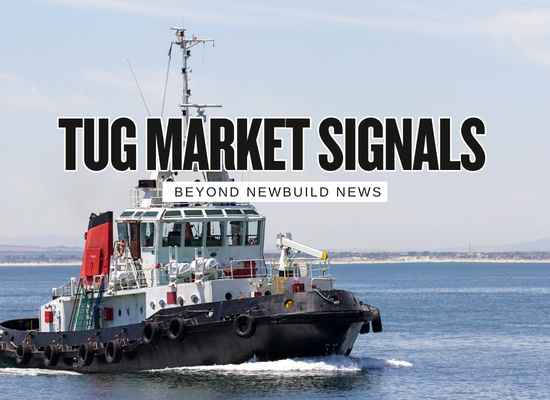
Newbuild announcements get attention because they are visible and easy to count, but they are not always the best early signal for where the tug market is actually moving. Some of the stronger indicators right now sit one layer deeper: ports tightening escort expectations, operators reshaping toward ship-assist and escort work, alliances widening geographic reach, low-emission tug programs moving from concept into repeat orders, digital port-call systems raising the value of dispatch precision, and terminal energy infrastructure changing what kind of tug capability gets paid for. Recent 2026 reporting from WorkBoat, MarineLink, Riviera, IMO, IAPH, and the World Bank points in that direction.
• terminals paying for higher-control towage, not just basic ship assist
• operators repositioning toward escort and ship-assist concentration
• towage alliances expanding coverage and commercial reach
• repeat low-emission tug orders instead of one-off pilots
• digital port timing making dispatch quality more valuable
• offshore energy and new fuel infrastructure creating adjacent tug work
One of the strongest live market signals is when a port or terminal starts tightening escort logic. That changes tug economics more directly than a generic fleet expansion announcement because it can increase required capability, squeeze availability, and improve pricing for the right asset class.
If a port starts requiring tethered escort for more movements or more vessel types, that is not just a harbor-rule footnote. It is a direct demand signal for higher-value towage.
Operator portfolio changes can be a sharper market signal than a shiny new tug launch. When a company sheds legacy transport assets and says it wants to concentrate on ship assist and escort, that tells you management believes the return profile and strategic future are stronger there.
Those decisions often reveal where margins and long-term demand look more attractive from inside the business.
A single electric or methanol tug can be a useful proof point, but repeat builds are a much stronger signal. They suggest that builders, operators, and ports are starting to see certain propulsion paths as operationally credible enough to move beyond symbolic first-of-kind status.
Repeatability is where a technology starts becoming a segment rather than a headline.
When independent towage groups expand through alliances rather than acquisition, the market signal is not about hardware. It is about commercial reach, coordinated service, and customer demand for broader geographic coverage without giving up local operating knowledge.
That matters because a stronger network can shift which operators appear competitive to global cargo interests and shipowners, even if local tug counts stay unchanged.
Future-fuel tools, safety frameworks, and port sustainability infrastructure may not look like direct tug stories at first glance. But they often shape the kinds of vessel calls a port wants, the way terminals manage risk, and the service expectations placed on marine-support providers.
In other words, a port’s energy transition plan can become a quiet tug-demand signal long before it becomes a tug contract line item.
A port can become more interesting for tug operators even if its traditional liner story is unremarkable. Offshore wind support, marine-construction logistics, and terminal energy projects can create new support, readiness, and marine-services demand that lifts the value of the local tug market.
That kind of shift often arrives through infrastructure news rather than through tug headlines, which is exactly why it is easy to miss.
Use this quick screen to estimate whether a tug market may be strengthening even without dramatic newbuild headlines.