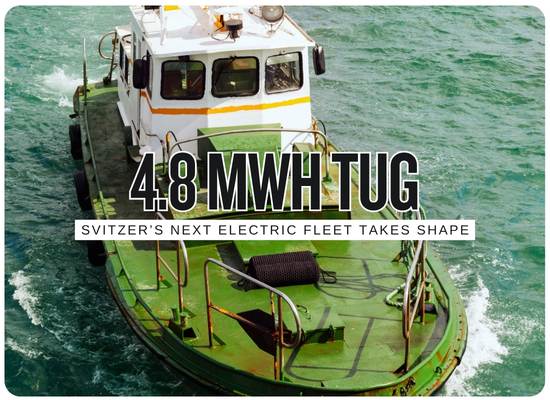
The battery is the headline, but integration is the deal
Svitzer’s new electric TRAnsverse fleet is built around a large 4.8 MWh battery system, but the commercial value depends on the full package: charging equipment, switchboards, power management, propulsion motors, thrusters, controls, deck machinery, crew procedures and lifecycle support.
Operator Impact Snapshot
MWh battery pack planned for each full-electric TRAnsverse tug in the Cochin-built series.
Four firm vessels are under contract, with options for up to four more units.
The TRAnsverse 2600e is a 26-metre electric tug design.
Each tug will use two Kongsberg US L-drive azimuth thrusters with 2.8-metre nozzles.
Each thruster will be powered by a 2,000 kW permanent magnet motor.
Sources: Svitzer and Cochin shipbuilding agreement, Kongsberg equipment package, Riviera equipment coverage, Svitzer electrification program.
Electric towage moves from vessel order to equipment architecture
The most important signal from the Svitzer project is that the electric tug is being treated as a fully integrated asset. Battery capacity matters, but the tug still has to perform close-quarters work, recover lines quickly, respond to pilot commands, manage peak loads, recharge inside port schedules and keep crews confident during abnormal operations.
That is why the equipment list matters. Kongsberg is not only supplying one component. Its scope connects the power architecture, automation, propulsion, thruster controls, deck machinery and shore charging. For ports considering electric tugs, the procurement lesson is clear: integration is the product.
| Equipment area | Reported package | Operating role | Buyer question |
|---|---|---|---|
| Battery | 4.8 MWh battery pack per tug | Primary energy source for zero-direct-emission harbor and terminal work. | Does the usable energy window match daily jobs, standby, and recovery time? |
| Charging | Necessary shore charging equipment | Connects tug availability to berth, grid and charging schedule. | Can the port deliver power fast enough without disrupting operations? |
| Switchboards | DC and AC switchboards | Distributes and protects electrical power across vessel systems. | Is the electrical architecture resilient enough for critical towage work? |
| Motors | Permanent magnet propulsion motors | Converts stored electrical energy into thrust with high response and efficiency. | Are motor service, cooling and redundancy built into the lifecycle plan? |
| Thrusters | Two US L-drive azimuth thrusters with 2.8-metre nozzles | Provides maneuverability for harbor, terminal and escort profiles. | Does thrust response match the port’s toughest ship-assist scenarios? |
| Controls | K-Chief, K-Chief PMS and AquaPilot | Coordinates automation, energy management and thruster response. | Will operators receive clear modes, alarms and training before service? |
| Deck gear | Hydraulic escort winch, two capstans and two chain stoppers per vessel | Connects electric propulsion power to real towing and escort work. | Does line-handling speed and recovery performance match the job? |
Procurement sequence for electric tug equipment
9 equipment decisions behind Svitzer’s new electric fleet
Battery capacity and usable reserve
The 4.8 MWh battery pack is the headline number, but the operating decision is really about usable energy. Operators need to plan around state-of-charge limits, battery reserve, emergency power, repeated high-thrust events, degradation, warranty conditions and charging frequency.
Shore charging as a fleet asset
Electric tug availability depends on shore charging as much as vessel design. The charger needs to fit berth access, utility capacity, cable handling, crew workflow, emergency disconnection, maintenance and job timing. The dock becomes part of the tug’s propulsion system.
DC and AC switchboard architecture
Switchboards do not receive the same attention as battery size, but they are central to reliability. The electrical architecture has to distribute power, isolate faults, protect critical systems and support safe operation across hotel loads, propulsion, charging and deck machinery.
Permanent magnet propulsion motors
Permanent magnet motors are a major efficiency and response-time decision. In a tug, the motor has to deliver immediate thrust response, handle repeated load changes, work with the cooling system and remain serviceable in a demanding harbor environment.
L-drive azimuth thrusters and nozzle size
The reported package includes two Kongsberg US L-drive azimuth thrusters with 2.8-metre nozzles. That is where battery energy becomes useful tug force. The thruster package must deliver maneuverability, bollard pull, responsiveness and efficiency in close-quarter work.
Automation and power management
K-Chief automation and K-Chief PMS are important because electric tug crews need the power system to behave predictably. Mode changes, battery use, alarm handling, charging state, load management and propulsion response should feel operationally simple even when the technical system is complex.
AquaPilot and operator interface
Controls are not just electronics. They shape how the captain feels the tug. AquaPilot connects the operator to thrust, maneuverability and response. In an electric tug, the control interface also has to match instant torque, energy management and repeated precision movements.
Escort winch and deck machinery
Kongsberg’s package includes a hydraulic escort winch, two capstans and two chain stoppers per vessel. That matters because a tug’s electric propulsion package is only useful if line handling, render-recovery speed, escort capability and deck workflow can keep up.
Service support and crew readiness
Electric tug equipment creates a new support model. Owners need battery diagnostics, charger support, software updates, high-voltage safety procedures, spare parts, warranty visibility, technician access and crew training before the vessel enters a busy harbor rotation.
Procurement signal for ports
The Svitzer package shows that electric tug procurement is becoming more professional and more integrated. The winning package is not just the biggest battery. It is the battery, charger, controls, propulsion and deck machinery working as a single harbor tool.
Buyer table for electric tug equipment
| Buyer priority | Strong equipment file | Weak equipment file | Commercial effect |
|---|---|---|---|
| Battery confidence | Capacity, usable reserve, warranty, degradation model and emergency margin are documented. | Battery size is quoted without duty-cycle proof. | Decides whether the tug can work the schedule customers expect. |
| Charging readiness | Charger, berth, grid, cable handling and utility timing are aligned. | Charging is treated as a later port project. | Can decide whether the tug is useful from day one. |
| Propulsion response | Motors, drives, thrusters, nozzles and controls are tested as a maneuvering system. | Components are bought separately with weak integration review. | Shapes pilot confidence and ship-assist performance. |
| Deck capability | Winch, capstans, stoppers, controls and crew workflow match escort work. | Deck machinery is underspecified against propulsion capability. | Prevents a powerful tug from being limited by line-handling bottlenecks. |
| Lifecycle support | Training, spares, remote diagnostics, warranty and service response are clear. | Support depends on ad hoc vendor calls after delivery. | Protects uptime, safety and crew confidence. |
Port profiles most likely to benefit
Short-cycle harbor assist
Strong candidate Predictable charging High visibilityElectric tugs are strongest when job cycles are predictable and the vessel can recharge around known berth windows.
Terminal-dedicated towage
Strong candidate Repeat work Customer pressureDedicated terminal work can make battery use, charging rhythm, maintenance planning and emissions reporting easier to control.
Mixed harbor and coastal assignments
Careful review Range pressure Backup needWider routes and unpredictable standby periods need a deeper duty-cycle study before battery-only operation is assumed.
Clean-port funding environment
Funding leverage Public reporting Fleet renewalElectric tug projects can become easier to justify when grants, customer requirements and community air-quality goals support the business case.
Electric tug equipment readiness checker
Use this tool to estimate whether a port, operator or newbuild project is ready for a 4.8 MWh electric tug package. The score highlights the equipment area most likely to need attention.