Tugboat low load emissions
Low load is the part of the tug day that needs a second look
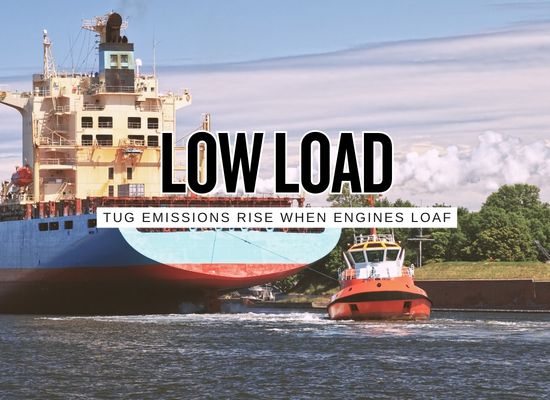
A harbor tug spends a lot of its working life waiting, creeping, lining up, assisting, surging, then waiting again. That is exactly where new real-world testing says emissions can behave differently than a neat engine-tier label suggests.
17
Harbor tugs measured in the new real-world testing campaign.
41K
Valid one-second observations retained after processing and quality control.
11.6-26.5
g/kWh NOx range reported across engine load bands.
3.4-5.5
g/kWh CO range, with CO rising under low-load and transient operation.
The finding in plain English
A tug can burn less fuel per hour at low load, but still emit more pollution per unit of useful work. Lightly loaded diesels, cool exhaust, incomplete combustion and quick throttle changes can make standby and slow maneuvering a bigger port-air problem than the fuel ticket suggests.
Research notes
The new Measurement study used onboard exhaust measurements from 17 harbor tugboats operating in seven Turkish ports, with synchronized 1 Hz data and load-resolved emission factors. Related NOx-control research and TNO’s low-load analysis both point to the same operating challenge: SCR performance depends on exhaust temperature, and low-load operation can fall outside the strongest aftertreatment window.
Sources: Real-world harbor tug emissions study, Tugboat SCR field study, TNO low-load NOx analysis, EPA harbor craft best practices, MARAD technical guide, Harbor Docking hybrid Gulf Coast newbuild.
Sources: Real-world harbor tug emissions study, Tugboat SCR field study, TNO low-load NOx analysis, EPA harbor craft best practices, MARAD technical guide, Harbor Docking hybrid Gulf Coast newbuild.
Data snapshot
| Operating mode | Emission concern | Reason it gets missed | Best first control |
|---|---|---|---|
| Standby | Engines stay ready while useful work is low. | Fuel burn looks modest, but hours add up close to people and terminals. | Shore power, battery standby, auto shutdown policy. |
| Slow transit | Large mains may run below their efficient load band. | Standard averages flatten the low-load penalty. | Hybrid mode, smaller gensets, right-sized dispatch. |
| Assist setup | Fast throttle changes produce transient spikes. | Steady-state test factors do not capture every maneuver. | Mode-by-mode data logging and PEMS testing. |
| Cool exhaust | SCR and related aftertreatment may underperform. | Compliance label does not prove real-time conversion efficiency. | Temperature monitoring, load management, control tuning. |
| Older high-hour engines | NOx, PM, CO and diesel exhaust exposure remain concentrated near the port. | Old engines can stay in service because the tug is still operationally useful. | Repower planning, engine-tier audit, annual-hour ranking. |
The owner takeaway
The cleanest tug investment is usually the one aimed at the actual duty cycle. If the tug spends half the day below efficient load, the best emissions project may be load management, shore power, hybrid standby, engine right-sizing or aftertreatment tuning, not simply a bigger engine or a newer nameplate.
Six fixes with the fastest practical value
Measure by mode
Separate standby, transit, assist, full pull and dockside operation. One daily average hides the problem.
Cut engine-on waiting
Use shore power, battery standby or shutdown rules where response time allows.
Track exhaust temperature
SCR effectiveness depends on heat. Low-load hours should be reviewed against the system’s active range.
Rank engines by hours
EPA recommends tracking annual service hours and engine-tier performance for harbor craft.
Use hybrid where it fits
Harbor-assist tugs are strong candidates when the day is mostly loitering, slow transit and short power bursts.
Ask suppliers for low-load proof
Request emissions behavior at 0-25% load and during transient maneuvering, not only rated-output data.
Low-load emissions exposure tool
Convert a tug’s low-load hours into a quick emissions exposure estimate. This is a planning tool, not a compliance test.
Use combined main-engine propulsion power.
Use the vessel’s real annual operating hours.
Standby, loitering, slow transit and light maneuvering.
Use percent of rated power during low-load operation.
Use measured data when available. Default is an illustrative value inside the reported range.
Default reflects the upper side of the reported CO range.
Estimate from shore power, hybrid standby, shutdown policy or better load management.
Low-load hours
1,650
Estimated annual hours in the operating zone most likely to hide emissions trouble.
Low-load NOx
29.0 t
Illustrative annual NOx estimate for the low-load portion.
Low-load CO
6.6 t
Illustrative annual CO estimate for the low-load portion.
Avoided NOx potential
10.2 t
Planning estimate using the selected reduction percentage.
Procurement note
A “clean tug” should not be bought only from a rated engine tier. Ask for low-load data, transient maneuver data, aftertreatment temperature behavior, idle strategy, shore-power readiness and hybrid control logic.