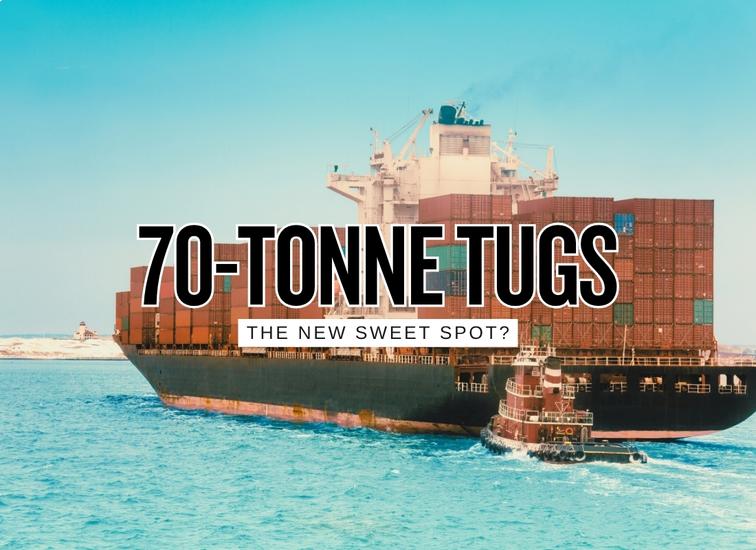
Seventy tonnes is starting to look less accidental
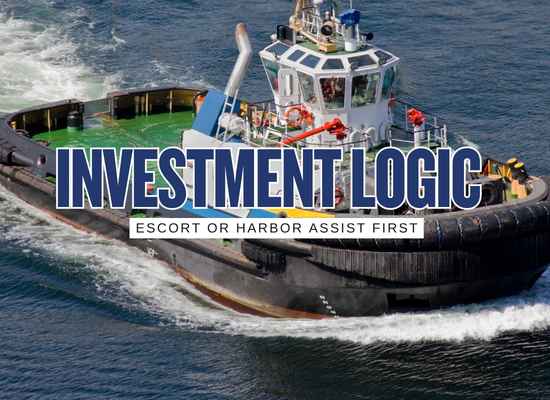
Tug operators have spent years chasing more power. The interesting move now is where several fleets are stopping. Around 70 tonnes gives a compact harbor tug enough muscle for today’s larger ships, FiFi capability and some escort work without automatically stepping into the cost and machinery of an 80-90 tonne specialist.
New 70-tonne ASD tugs SAAM will build locally in Brazil.
Additional 70-80 tonne SAAM newbuilds headed to other Latin American markets.
Wilson Sons’ new Brazilian ASD 2312 series is clustered around the same power band.
New Panamax ship length now accommodated at Rio after channel upgrades.
Five reasons operators are clustering here
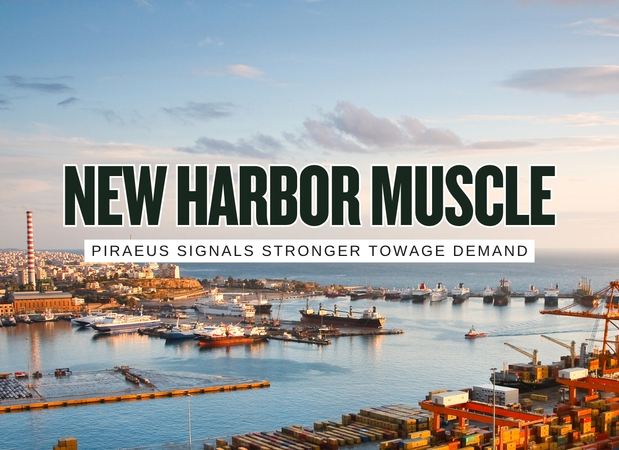
Brazilian ports are preparing for deeper-draft and New Panamax traffic. More windage and displacement increase the value of stronger harbor-assist tugs.
Modern designs can package roughly 70 tonnes into a 23-24 metre ASD hull, giving ports serious pull without requiring a large tug footprint.
SAAM’s Brazilian tugs will carry FiFi 1. Damen’s 70-tonne ASD 2312 can be configured for 1,200-2,400 m³/h firefighting capacity.
Seventy tonnes can support escort assignments when hull, winch and class are designed for it. Bollard pull alone does not make an escort tug.
The buyer gets a meaningful jump over older 40-60 tonne fleets without automatically paying for the machinery and equipment needed for an 80-90+ tonne asset.
The 60 vs 70 vs 80+ decision
| Decision point | 60 tonne class | 70 tonne class | 80+ tonne class | Buyer read |
|---|---|---|---|---|
| Routine harbor assist | Strong fit | Strong fit with extra margin | Often more capability than required | 70 tonnes gives room for fleet growth without jumping too far ahead of demand. |
| New Panamax | Port and condition dependent | Increasingly common fit | Strong fit | Brazil’s 70-tonne newbuild trend is closely aligned with larger ship calls. |
| Escort work | Limited on demanding jobs | Possible with correct hull, winch and notation | Stronger fit for high-force escort | Do not confuse static bollard pull with certified indirect-force capability. |
| FiFi 1 | Available on some designs | Commonly packaged | Commonly packaged | 70 tonnes can combine firefighting with routine ship-assist economics. |
| Confined harbor | Compact options | Very compact options around 23-24 m | Often larger hull and machinery package | This is one of the strongest arguments for 70 tonnes. |
| Capital burden | Lower | Middle | Higher | The right comparison is lifecycle cost per job, not dollars per tonne of bollard pull. |
SAAM is ordering four 70-tonne ASD/FiFi 1 tugs while Wilson Sons is putting a new 70-tonne-class series into service for larger ship traffic. Two major operators independently landing in nearly the same range is more meaningful than a single vessel order.
SAAM is also buying 80-tonne escort-capable vessels elsewhere in Latin America. That suggests 70 tonnes may be the broad harbor-work sweet spot while 80+ tonnes remains attractive where escort force, terminal risk or very large ships justify the premium.
The capital-cost clue
SAAM has not publicly disclosed the purchase price of the four Brazilian tugs, so assigning a dollar premium would be guesswork. The machinery comparison still shows the direction of travel.
Bollard pull should not be bought in isolation. An inexpensive 70-tonne tug with the wrong winch, poor indirect-force characteristics or insufficient firefighting package may be less useful than a correctly specified 60-tonne vessel. Conversely, an 80-90 tonne escort tug can be wasted capital if almost every job is ordinary harbor assist.
Bollard pull sweet-spot checker
Use the port profile to see which power band deserves closer evaluation.