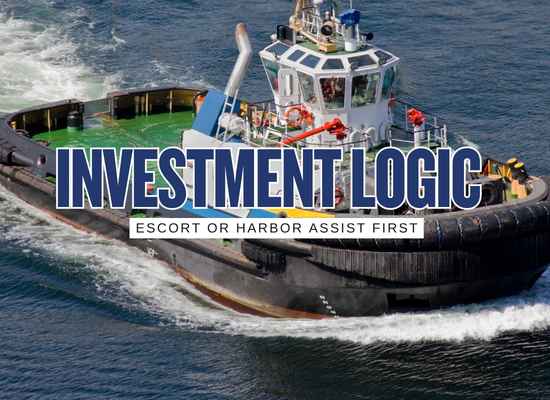
Right now, the stronger investment logic is not universal. Escort tugs look stronger first in ports tied to LNG, petrochemical, export-terminal, and higher-consequence ship movements where authorities and customers are willing to pay for added control and safety margins at speed. Harbor assist tugs still look stronger first in a much larger share of everyday port markets because they are more versatile, easier to keep utilized across routine shiphandling work, and usually easier to justify on a recurring cash-flow basis. Recent 2026 signals make that split clearer: new hybrid escort-tug programs are being built for Louisiana LNG service, new escort-capable units are being ordered for Piraeus, and some ports are tightening tug escort expectations, while mainstream ASD harbor tugs remain the standard multi-purpose tool across container, bulk, and terminal operations.
• local authorities or terminal customers require or reward escort margins
• rates can support higher-capability assets
• environmental, bridge, channel, or terminal risk is commercially decisive
• daily utilization matters more than premium specialization
• the tug needs to cover multiple berth, carrier, and cargo scenarios
• capital discipline favors versatile ASD-style fleet additions
Escort towage is designed for a more demanding control role than normal ship-assist. Robert Allan notes that a true escort tug must be able to provide steering or braking forces to a ship at speeds above 6 knots, typically through indirect towing that relies on hull, skeg, and propulsion working together. That makes escort tugs more specialized assets, but it also makes them more valuable in places where authorities and customers care deeply about control margins, environmental exposure, and terminal consequence.
The recent U.S. Gulf example is telling. WorkBoat reported last week that four hybrid escort tugs are being built for Woodside Louisiana LNG service, and the article notes they are engineered for high-performance indirect steering forces and bollard pull to handle the world’s largest LNG carriers. That is not ordinary harbor utility buying. It is capital being directed toward specialized escort capability because the terminal profile justifies it.
Broadly speaking, harbor assist tugs still have the stronger everyday investment case because they match more ports’ actual work mix. Damen’s ASD line is marketed as a cost-effective, reliable tool for handling container and bulk carriers in harbors and terminals, and it explicitly describes ASD tugs as multi-purpose vessels for push-pull, harbor assisting, and escort towing. Robert Allan makes a similar point through its RAmparts line, describing it as one of the industry’s most versatile and widely accepted multi-purpose ASD families.
That versatility matters because it supports higher utilization across a broader range of standard ship-assist jobs. In an ordinary commercial harbor, that often translates into a stronger recurring cash-flow story than a more specialized escort unit that may be underused unless local traffic and port rules really support it.
Escort tug economics can improve very quickly when local rules or terminal expectations shift. Moran Shipping’s April 24 Charleston port bulletin said a forthcoming Captain of the Port statement would require tethered escort tugs for certain ships calling at Nucor, Ineos, and Nexans, and it explicitly noted that the new procedure would affect harbor operations and tug availability. That kind of local change can turn escort capability from a niche advantage into a capacity bottleneck very fast.
In other words, escort investment logic can strengthen suddenly when a port starts attaching more formal safety value to escort coverage. Harbor assist tugs do not gain the same step-change uplift from those regulatory shifts unless they are also genuinely escort-capable.
The best escort-tug investment stories right now are not random. They tend to cluster around LNG terminals, tanker movements, sensitive waterways, and major hubs where higher-performance tug capability can be defended through safety, asset protection, or high-value terminal continuity. The Louisiana hybrid escort program is one example. The Piraeus fleet expansion is another. MarineLink reported on April 6 that two new tugboats are being built for the Port of Piraeus to handle the increasing demands of one of Europe’s busiest hubs.
These cases do not prove escort logic is stronger everywhere. They show where it is strengthening first: in ports that can justify higher-capability towage through cargo value, ship size, and operational consequence.
For a tug owner or investor looking across the full market rather than at one especially demanding port, harbor assist still looks like the safer broad-market bet in 2026. It aligns with recurring ship-assist work, standard terminal operations, and the need for multi-purpose fleet coverage. That is why the core harbor ASD and related multi-purpose tug segments remain so widely used and standardized.
Escort tugs, however, may offer the stronger upside in the right niche because they are harder to replicate, more defensible where escort rules or expectations harden, and more closely tied to premium safety-critical service. The stronger logic right now therefore depends on whether the investor is chasing broad utilization or higher-value specialization.
Use this quick screen to estimate whether a port profile leans more toward escort-tug investment or harbor-assist investment.
Near zero = both can make sense depending on contracts
Positive score = escort logic is stronger