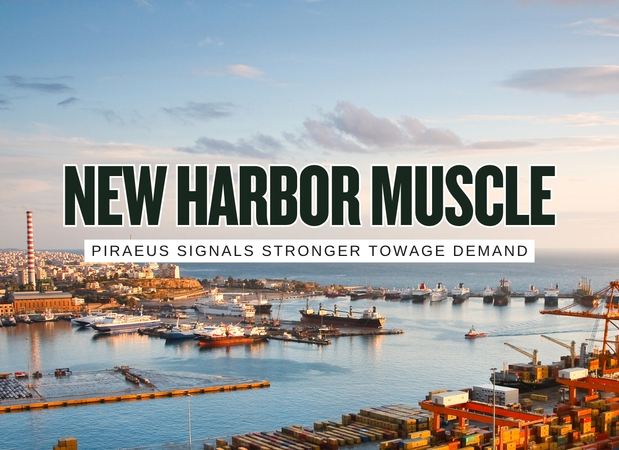
The Mediterranean tug market is getting a practical upgrade cycle, and Piraeus is one of the clearest signals. Med Tugs has ordered two new Sanmar-built tugs for Piraeus through SVS, a joint venture involving Vernicos Scafi, Spanopoulos and Lyboussakis. Reports describe the order as a roughly €21 million investment, with 80-tonne and 90-tonne bollard pull RAstar vessels scheduled for delivery in September 2026 and September 2027. That kind of muscle fits a port handling large container ships, cruise vessels, ferries, car carriers, tankers, repair traffic and tight harbor movements. The broader Mediterranean signal is not only Greece. Turkish and Italian-linked tug orders, EU shore-power and fuels policy, cruise growth, larger ship calls, and terminal reliability expectations are all pushing ports and operators toward stronger, more capable, more efficient harbor fleets.
Piraeus shows why busy ports are ordering more tug muscle
The new tug orders in Piraeus are not just a local fleet refresh. They point to a wider Mediterranean pattern: bigger ships, tighter berth windows, cruise growth, ferry density, terminal expansion, port safety expectations, escort work and cleaner-port planning are pushing operators toward stronger, more versatile and more technically capable harbor fleets.
Reported value of the Med Tugs order for two Sanmar-built tugboats for Piraeus operations.
Reported bollard pull for the larger of the two ordered RAstar tugs, with the other listed at 80 tonnes.
Annual TEU throughput figure reported for Piraeus in recent coverage describing the port’s rise as a Mediterranean hub.
EU shore-power and clean-fuel policy deadlines are adding pressure on major ports to modernize the wider operating ecosystem.
The signal from Piraeus
Piraeus has a rare mix of cargo, ferry, cruise, vehicle, ship repair and regional gateway activity. That mix creates a demanding tug environment. A modern tug there must be able to handle large commercial ships, assist on tight schedules, support multiple vessel types and fit into a port that is under pressure to keep growing while staying safer, cleaner and more reliable.
Sources: Riviera Maritime Media, Ship2Shore, MarineLink, European Commission FuelEU Maritime.
The upgrade wave is about capability, not just horsepower
Bollard pull is the visible number, but it is not the whole story. A Mediterranean port upgrade can require better escort performance, faster response, more precise shiphandling, improved crew visibility, stronger winch and fender systems, redundancy, data logging, lower fuel burn, and the ability to support a wider range of vessel calls.
Busy ports are not buying new tugs only because ship sizes have grown. They are buying insurance against delays, congestion, safety incidents, weather disruptions, terminal bottlenecks and customer frustration. The tug fleet becomes part of the port’s reliability package.
9 reasons Piraeus and other busy ports are ordering new muscle
① Larger ships need higher safety margins
Mediterranean ports increasingly handle larger container ships, cruise ships, car carriers, ferries, tankers and special project cargo. Even when a berth can physically accept a vessel, towage has to manage the approach, turning basin, windage, current, traffic, pilot instructions and emergency margin.
A stronger tug gives the port more control during the moments that matter most: final approach, departure, turning, holding position and recovering from an unexpected movement.
② Piraeus is a multi-market port, not a single-purpose terminal
Piraeus is not only a container story. It also has heavy ferry activity, cruise traffic, vehicle movements, ship repair and broader Eastern Mediterranean gateway functions. That creates a dense operating environment where different vessel types can compete for water space, berths and timing.
A tug fleet in that environment needs flexibility. A harbor tug may be asked to support container operations, cruise movements, ferry disruption response, emergency standby, repair-yard moves or special vessel shifts within a compressed window.
③ Schedule reliability is now part of port competitiveness
A delayed ship assist can ripple through cranes, trucks, yard planning, pilotage, berth windows, ferry departures, cruise passenger flows and terminal labor. In a busy Mediterranean hub, towage reliability is not a background service. It is one of the invisible systems that keeps port capacity usable.
New tug capacity can help reduce schedule fragility. It gives operators more flexibility when multiple large vessel moves stack up, when weather changes, or when a berth plan shifts at short notice.
④ Cruise and ferry density raises public visibility
Cruise and ferry operations put tug activity closer to passengers, tourism districts, city officials, local businesses and public waterfront areas. That means tug performance is not only an industrial matter. It can affect the port’s public image.
Stronger, newer and cleaner-looking tugs help ports project competence. Older, smoky or visibly strained tug operations can send the opposite message, especially in ports trying to sell themselves as modern passenger and logistics gateways.
⑤ EU climate rules are changing the port investment mood
FuelEU Maritime and EU alternative-fuels infrastructure rules are not tugboat rules in a simple one-to-one sense. But they are changing the climate around port investment. Container and passenger ships face growing pressure around energy use, emissions intensity and shore-side electricity connection at relevant ports.
That makes ports more likely to think about the entire harbor ecosystem. If a port is investing in shore power, clean-fuel planning and emissions reporting, older harbor craft become more noticeable in the operating picture.
⑥ Eastern Mediterranean volatility increases standby value
Ports in the Eastern Mediterranean can be affected by rerouting, security concerns, energy flows, regional trade shifts, cruise redeployments and changing vessel schedules. A stronger tug fleet gives a port more resilience when traffic patterns move quickly.
This is not only about daily ship assist. It is also about emergency response, casualty assistance, weather disruption, temporary congestion, terminal recovery and confidence that port services can absorb sudden demand.
⑦ Shipyards are offering proven, fast-deployable designs
Turkish and European tug builders have created a mature market for ASD, RAstar and other high-performance harbor tug designs. Operators do not always need to finance a one-off experimental vessel. They can buy from established design families with known bollard pull, escort features, class pathways and delivery experience.
That lowers the practical barrier to fleet renewal. A port operator or towage company can move from need to order faster when the design, yard, equipment package and support model are already familiar.
⑧ Terminal growth changes towage risk tolerance
Ports that expand container, cruise, ferry or energy infrastructure cannot afford a towage fleet that becomes the weak link. A terminal investment may add cranes, berths, yard systems and gate capacity, but vessel movement still depends on pilots, tugs, weather windows and marine coordination.
Stronger tugs protect the value of terminal investment by helping the port use its physical infrastructure more consistently. A berth is only productive if ships can arrive, turn and depart safely within the planned window.
⑨ Fleet age is becoming harder to hide
Older tugs can still perform valuable work, but the bar is rising. Ports, terminals and customers are paying more attention to emissions profile, crew safety, data capability, uptime, noise, visibility, fuel burn and maintenance reliability.
In a competitive port region, an aging tug fleet can become a commercial disadvantage even before it becomes a regulatory problem. Newer tugs give operators a stronger story in tenders, customer reviews and port development discussions.
Regional signals pointing to a broader upgrade cycle
Piraeus and Greek port capacity
80T bollard pull 90T bollard pull RAstar designs 2026 and 2027 deliveryThe Med Tugs order is a clear sign that Greek towage providers are preparing for larger, more demanding and more reliability-sensitive port work. Piraeus is the headline, but the logic can apply across other busy Greek ports.
Türkiye as a tugbuilding and operating hub
Sanmar Damen deliveries ASD fleet renewal Regional supportTürkiye remains central to the regional tug supply chain, both as a builder and as a major maritime market. Recent contracts involving Turkish operators and shipyards show that the region can move quickly when operators need new ASD capacity.
Italian and LNG terminal demand
Harbor operations Escort duty 65T class tugs LNG supportRecent tug orders connected to Italy include harbor units and a larger RAstar tug designed for LNG terminal and escort duties. That points to a market where ports and terminals need both day-to-day harbor assistance and specialized energy-terminal capability.
EU port decarbonization pressure
FuelEU Maritime Shore power Alternative fuels 2030 planningAs major European ports prepare for shore-power and clean-fuel obligations, towage fleets may face indirect pressure to modernize. A port cannot easily market a cleaner berth ecosystem while ignoring highly visible harbor craft indefinitely.
Mediterranean tug upgrade pressure check
This quick tool estimates whether a port or towage operator is facing low, rising, medium or high pressure to upgrade tug capacity. It is a planning guide for fleet strategy, not a replacement for naval architecture or port-risk analysis.