The replacement risk starts before delivery
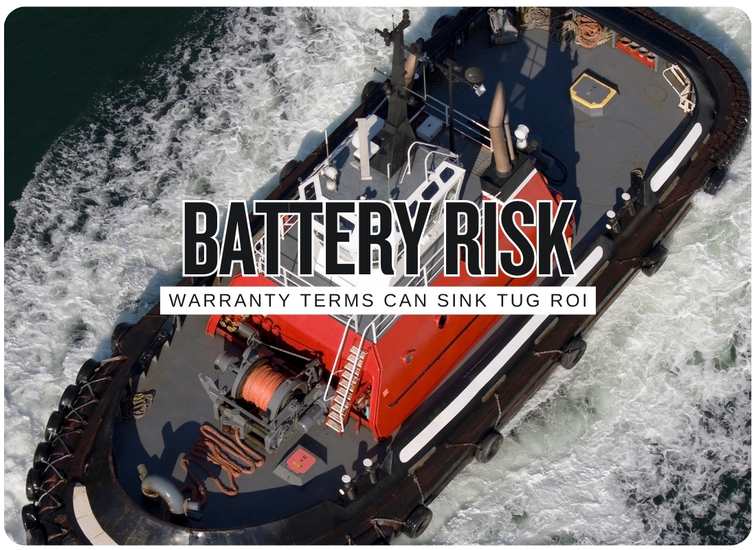
I would treat the battery warranty as part of the tug’s earning capacity, not as paperwork to file after commissioning. If the warranty does not match the tug’s real duty cycle, the vessel can look profitable on delivery day and painful halfway through the operating agreement.
Operator Impact Snapshot
MWh battery packs are planned for Svitzer’s new Kongsberg-equipped electric TRAnsverse tug series.
Four Svitzer electric TRAnsverse 2600e tugs are under contract, with options for four more.
Echandia says 30,000 cycles without mid-life replacement was a key requirement for India’s first fully electric tug at Kandla Port.
Echandia Core lists usable capacity as 90% of installed capacity, based on a 5% to 95% SOC window.
Echandia Core lists 70,000 cycles at 70% depth of discharge for a high-power short-cycle configuration.
Sources: Kongsberg Svitzer electric tug package, Svitzer Cochin electric TRAnsverse agreement, DNV battery degradation and warranty evaluation, DNV battery warranty terms, Echandia Kandla electric tug battery, Echandia Core specifications.
The battery warranty is a commercial instrument
An electric tug battery warranty is not the same as a simple equipment warranty for a pump, winch or electronics cabinet. The battery is tied directly to earning capacity. If the tug cannot complete its planned daily work at year eight, year ten or year fifteen, the owner may face lost utilization, reduced dispatch flexibility, charger dependence, unexpected module replacement, extra yard time or a contract-performance dispute.
This is the reason buyers should price warranty language before delivery. The installed battery size is only the starting number. The contract should define how much energy remains, how many cycles are guaranteed, how state of health is measured, which operating conditions void or reduce coverage, who pays labor, who supplies replacement modules, and whether performance shortfall has a financial remedy.
| Warranty term | Owner risk | Supplier-friendly wording | Buyer protection to request |
|---|---|---|---|
| Guaranteed cycles | Battery reaches cycle limit before the tug reaches the contract term. | Cycles counted only under strict charge and discharge conditions. | Cycle guarantee based on the real tug duty profile, plus clear counting method. |
| Retained capacity | Remaining capacity is too low for the planned daily work even if the pack is technically inside warranty. | Capacity guarantee uses a favorable test condition or narrow measurement window. | Capacity test procedure, energy-at-discharge definition and practical operating threshold. |
| Calendar aging | The battery degrades even during low-use periods, reducing future dispatch value. | Calendar degradation is buried in one broad degradation curve. | Separate calendar aging curve and remedy if the tug is underused by contract design. |
| Temperature | Hot battery rooms, charger peaks or cooling faults accelerate degradation. | Temperature limits are tied to owner operation, even when system cooling is supplier-controlled. | Measurement point, exceedance rule, cooling responsibility and alarm data access. |
| Usable SOC | Installed MWh looks large, but only part of it can be used without hurting warranty coverage. | SOC limits restrict daily use or require conservative charging habits. | Guaranteed usable energy window that matches dispatch needs, reserve policy and emergency mode. |
| Replacement modules | Owner pays for module gaps, compatibility changes or partial pack replacement. | Replacement limited to failed component, not lost energy performance. | Module availability, chemistry compatibility, logistics, customs, spares and obsolescence language. |
| Labor and downtime | Parts are covered but yard time, technicians, travel, access work and lost revenue are not. | Warranty covers component only, with labor or removal excluded. | Labor, travel, craneage, testing, recommissioning and response-time commitments. |
| Performance guarantees | The tug is still operable but misses promised range, charge time or daily job count. | Guarantee tied to ideal operating profile rather than real port schedule. | Guaranteed daily mission profile, remedies, liquidated damages and data source of truth. |
Battery warranty pricing sequence before delivery
8 warranty terms electric tug owners should price before delivery
Guaranteed cycles
Tug batteries can cycle hard because harbor work repeats. A daily harbor-assist schedule may include several partial cycles, quick recharge windows and high-power bursts. The warranty needs to say whether a cycle means full equivalent cycle, discharged MWh throughput, partial cycle, charge event or supplier-calculated equivalent.
The owner should compare guaranteed cycles with the actual operating agreement. A battery that looks strong at 10,000 cycles may be weak for a tug expected to work multiple charge and discharge events every day.
Retained capacity
Retained capacity is the number that can quietly change the tug’s earning profile. If the tug needs a certain usable MWh to complete a daily rotation, a lower retained-capacity threshold can force slower dispatch, extra charging, backup tug support or a mid-life module project.
Owners should avoid vague language like “normal degradation.” The contract should show retained capacity by year, test method, allowable measurement tolerance and the remedy when capacity drops below the warranted curve.
Calendar aging
Batteries age even when the tug is not working hard. That matters for electric tugs tied to seasonal traffic, ramp-up contracts, delayed port charging projects, fleet redeployment or new terminal schedules. A lightly used battery can still lose capacity over time.
Calendar aging should be separated from cycle aging in the commercial model. If the owner only models cycles, the tug can appear protected even while the calendar term is quietly reducing future capacity.
Temperature limits
Temperature language can decide whether the warranty is practical in a real tug. Battery-room heat, cooling faults, tropical ports, repeated fast charging, high C-rate discharges and berth-side ventilation limits can all affect degradation.
The owner should not accept temperature limits without knowing the measurement point. A warranty can look protective until the buyer learns that the relevant temperature is the highest cell, an average rack value, a battery-room value or a daily average calculated from BMS data.
Usable SOC window
Installed MWh is not always usable MWh. The warranty may restrict average SOC, maximum SOC, minimum SOC, depth of discharge or time spent at high state of charge. These limits can protect the cells, but they can also reduce the tug’s practical workday.
For an electric tug, the useful number is the guaranteed usable energy inside the allowed SOC window. A tug with 4.8 MWh installed is not commercially equivalent to another 4.8 MWh tug if one can use a much larger safe window.
Replacement modules
A battery replacement event may not mean swapping the entire pack. It may mean replacing modules, racks, strings, cooling components, contactors, sensors or control hardware. The warranty should define which components are covered and whether replacements restore energy performance or merely replace failed parts.
This is also an obsolescence issue. If a module design changes, the owner needs compatibility language, software update support and a pathway to keep the vessel certified and serviceable.
Labor and downtime
A warranty that covers parts but excludes labor can still be expensive. Tug owners may face technician travel, craneage, insulation removal, access panels, class attendance, high-voltage testing, software commissioning, sea trials and lost hire during the repair window.
The warranty should say who pays for labor, how fast the supplier must respond, whether local technicians are qualified and whether the owner receives compensation if repair time exceeds the agreed threshold.
Performance guarantees
The best electric tug warranty should connect battery condition to vessel performance. The owner needs more than a lab-style capacity statement. The warranty should support a mission profile: number of assists, energy per day, charging time, power availability, reserve margin and availability targets.
Performance guarantees are especially important when the tug is sold into a long-term port or terminal service agreement. A battery that remains technically inside warranty can still disappoint if the tug cannot complete the customer’s promised daily schedule.
The warranty should match the commercial promise
Electric tug buyers should attach the battery warranty to the same work profile used in the sale case. If the business case assumes five or more high-power operating cycles per day, fast charging, high berth availability and no mid-life replacement, the warranty should be written around those assumptions.
Supplier pricing map
Battery supplier
Cycles Capacity ReplacementThe battery supplier should provide the degradation curve, warranted capacity, cycle-count method, replacement-module plan, thermal assumptions and the data needed to prove a claim.
System integrator
Controls Charging DataThe integrator should connect battery performance to power management, charger behavior, propulsion load, alarms, reporting and the vessel’s operating modes.
Shipyard
Access Installation ReworkThe shipyard should make future module replacement practical by designing access, lifting, ventilation, cabling, insulation and class documentation around the battery lifecycle.
Port or terminal customer
Mission Availability ScheduleThe customer’s daily service requirement should be visible in the warranty model, because the battery is only valuable if it supports the promised towage schedule.
Electric tug battery ROI shock calculator
Estimate how much warranty gaps, retained-capacity limits and replacement responsibility can hurt the ROI of an electric tug battery package.