Future fuel fires are changing tug response planning
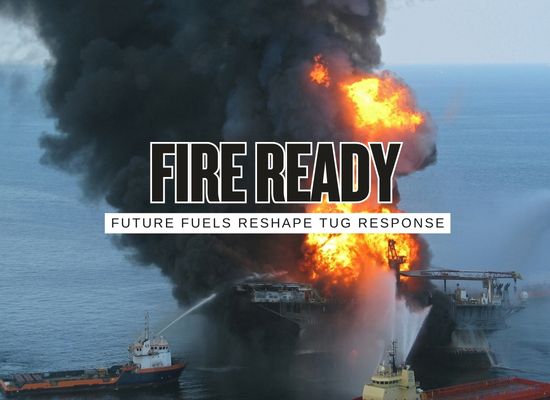
A new industry focus on tug firefighting has put alternative fuels, lithium-ion cargo hazards, energy storage systems, crew training, liability, and multi-agency coordination back in the spotlight. The latest discussion follows the British Tugowners Association’s firefighting guide and comes as ship fires remain one of the most complicated casualty risks facing ports, salvors, tug owners, insurers, and emergency responders.
Operator Impact Snapshot
Reported ship fire incidents during 2024, according to Allianz’s current Safety and Shipping Review.
Year-over-year increase in reported ship fire incidents in that review.
Fire incidents involving container, cargo, and ro-ro vessels, representing roughly 30% of reported fire incidents across vessel types.
The British Tugowners Association guide is being used as the current framework for tug firefighting preparedness discussion.
The story behind the safety alert
Tugboats are often among the first useful marine assets near a fire casualty. They can cool boundaries, control movement, push water through monitors, hold a damaged vessel in position, assist evacuation, protect terminals, support salvors, and help keep a casualty away from bridges, berths, traffic lanes, or sensitive shoreline. That role has always involved risk. The difference now is that the fire environment is changing faster than many legacy procedures were written for.
A conventional engine-room fire, a container-stack fire, a battery thermal runaway event, a methanol-fuel concern, a hydrogen-related emergency, and an LNG fuel incident do not create the same tactical picture. They can require different standoff distances, different information before approach, different protective equipment, different coordination with shore responders, and different decisions about whether the tug should attack the fire, cool exposures, control drift, or remain outside the hazard zone.
Commercial signal
Firefighting capability is moving from a brochure feature to a risk-management issue. Owners, ports, insurers, and charterers may start asking more specific questions about crew training, monitor capacity, alternative-fuel awareness, communications plans, and command structure before relying on a tug in an emergency.
| Risk area | Operational concern | Tug owner response | Port or insurer angle |
|---|---|---|---|
| Li-ion batteries | Thermal runaway, re-ignition, toxic smoke, difficult cargo access. | Train crews on standoff, cooling support, smoke exposure, and command limits. | Expect better pre-incident planning for container, ro-ro, and terminal fire scenarios. |
| Alternative fuels | Different fire behavior, vapor risk, fuel-specific response limits. | Build fuel-specific decision cards for LNG, methanol, hydrogen, ammonia, and battery systems. | Contractors may need to show fuel-awareness training and emergency coordination plans. |
| Command structure | Confusion between tug master, port, salvor, ship crew, fire service, and coast guard. | Define reporting lines and operating authority before the casualty. | Ports may want written multi-agency plans instead of informal expectations. |
| Legal exposure | Questions around duty to respond, crew safety, equipment limits, contract authority, and pollution risk. | Review towage terms, emergency response language, and refusal thresholds. | Insurers may look closely at training records and decision documentation. |
| Equipment reality | Fire monitors, pumps, foam, PPE, communications, breathing protection, and crew capacity may not match the casualty. | Audit firefighting equipment against actual port and vessel risk profile. | Ports may require capability statements rather than generic “FiFi” claims. |
7 operating lessons from the new fire-response focus
① Fire response starts before the alarm
A tug crew should not be learning the command chain while smoke is already rising from a ship. The owner, port, terminal, fire department, coast guard, pilot group, and salvor need a shared understanding of who directs the tug, who decides standoff distance, who confirms cargo hazard information, and who can stop an unsafe approach.
② Battery fires change the safe-distance conversation
Lithium-ion battery hazards can involve thermal runaway, toxic smoke, re-ignition, water-access problems, and delayed escalation. A tug’s ability to put water on a casualty is valuable, but the approach angle, smoke plume, crew protection, and retreat plan become critical.
③ Alternative fuels require fuel-specific response cards
LNG, methanol, ammonia, hydrogen, battery systems, and conventional fuels do not create the same fire or vapor profile. Tug crews need plain-language guidance that can be used quickly, not a long technical manual that stays in the office.
④ The tug’s job may be control, not attack
In some casualties, the safest and most useful tug role may be holding position, cooling exposures, preventing drift, moving other assets, supporting evacuation, or keeping the casualty away from infrastructure. Direct fire attack is only one possible mission.
⑤ Crew training is now a commercial differentiator
Ports and charterers increasingly want proof. A tug owner that can show drills, fuel-specific training, equipment checks, and command coordination may be more credible than an owner relying only on vessel specifications.
⑥ Contract terms need emergency clarity
Emergency response can blur normal commercial lines. A tug may be asked to respond outside a routine towage service, near a dangerous casualty, under public pressure, with incomplete cargo information. That creates legal and insurance questions.
⑦ Ports should map tug capability before an incident
A port should know which local tugs have monitors, pump capacity, foam capability, trained crews, PPE, breathing protection, thermal cameras, communications compatibility, and practical approach limits. Waiting until the fire starts is too late.
Stakeholder readout
For tug owners
The near-term task is to turn firefighting capability into documented readiness. That means equipment audits, command protocols, crew drills, alternative-fuel awareness, and clear limits on when a tug should approach, cool, tow, hold position, or stand off.
For port operators
Ports should treat tug firefighting as part of emergency planning, not an informal local assumption. A current capability matrix can help identify which tugs can support specific casualty types and where outside assistance is needed.
For insurers
Fire response readiness may become easier to evaluate through training records, equipment maintenance, drills, emergency contracts, and documented decision authority. Claims questions can get harder when the response involved new fuels or battery cargoes.
For suppliers
The market opening is not only fire monitors. It includes thermal cameras, portable gas detection, PPE, communications, crew training, scenario software, foam systems, remote monitoring, and practical emergency-response documentation.
Tug firefighting readiness score
This tool gives operators and port teams a quick readiness score for fire-response planning. It is not a legal or class assessment. It is designed to show whether a tug or local tug group looks prepared for complex shipboard fire support.
Readiness bar
Start with a basic audit of equipment, drills, and command contacts.
Action checklist for the next safety meeting
① Build a local casualty map
Identify high-risk areas: container berths, ro-ro terminals, fuel docks, anchorages, ferry terminals, bridge approaches, repair yards, and locations where a drifting casualty could quickly become a larger port problem.
② Confirm vessel-by-vessel capability
List each tug’s monitors, pump capacity, foam, communications, PPE, breathing protection, thermal tools, crew training level, and practical operating limits.
③ Add future-fuel briefings
Crews should have clear guidance for battery cargo, LNG, methanol, hydrogen, ammonia, and mixed-cargo uncertainty. Keep it practical enough to use during a real callout.
④ Run one multi-agency drill
Bring together the port, tug operators, pilots, fire service, terminal teams, coast guard, and salvors. The biggest failures often come from coordination gaps, not a lack of water flow.
⑤ Review contract and insurance language
Make sure emergency response authority, crew-safety rights, liability, equipment limits, and documentation requirements are not being improvised during the incident.