The best tug power choice depends on the port day
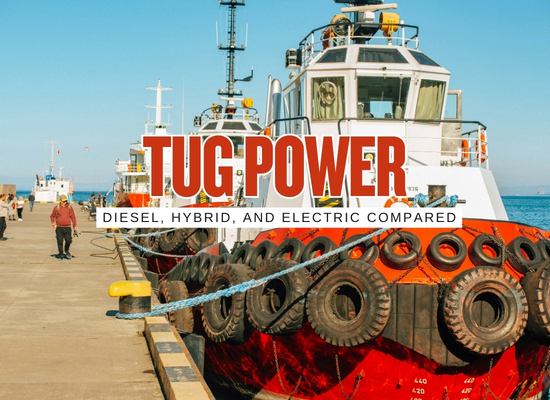
Diesel, hybrid, and electric tugs can all be the right answer in the right harbor. The costly mistake is comparing them only by purchase price or emissions label. Operators need to compare full duty cycle, standby behavior, charging access, fuel cost, maintenance support, bollard pull, crew routine, port grid capacity, and the customer contracts the tug must protect.
Crowley’s eWolf uses a large marine battery system and is designed for daily electric ship-assist operations in San Diego.
Several electric harbor tug designs are now built around roughly 70 tonnes of bollard pull, comparable with many modern harbor-assist expectations.
Damen states that proven electric tug designs can complete multiple cycles and recharge in around two hours when port charging supports the vessel.
EPA Clean Ports Program funding is supporting zero-emission port equipment, infrastructure, and air-quality planning.
Sources: Corvus eWolf system, Crowley eWolf christening, HaiSea ElectRA 2800 tugs, ABB ElectRA technology, Damen electric tugs, EPA Clean Ports Program.
The real comparison is not fuel type alone
Tug power decisions have become more layered because the port is now part of the propulsion system. A diesel tug brings its energy onboard in a liquid fuel tank and can refuel quickly in many locations. A hybrid tug still has fuel flexibility but adds batteries, electric drives, or energy management to reduce inefficient running and improve response. A fully electric tug shifts much more of the planning burden to the dock: charger capacity, grid interconnection, berth availability, utility rates, backup power, and dispatch discipline.
That means the same tug design can be a smart purchase in one harbor and a risky purchase in another. A short-cycle terminal with clear arrival windows, strong shore power, and local emissions pressure may favor electric. A mixed-duty operator doing harbor assist, standby, coastal work, emergency response, and unscheduled towing may still need diesel or hybrid flexibility.
| Power choice | Cost profile | Range and endurance | Best port fit | Watch item |
|---|---|---|---|---|
| Diesel | Lower infrastructure cost, familiar maintenance, fuel cost exposure, emissions compliance pressure. | Strong endurance, fast refueling, broad route flexibility. | Mixed work, coastal towing, standby, emergency response, smaller ports, uncertain schedules. | Engine tier, fuel price, emissions rules, customer clean-air scoring. |
| Hybrid | Higher capex than diesel, lower low-load waste, added battery and control complexity. | Good flexibility because diesel remains available for longer or harder jobs. | Ports with idle time, short bursts of high power, variable load, emissions pressure, limited charging certainty. | System integration, battery replacement planning, crew training, energy management quality. |
| Electric | Higher vessel and infrastructure planning cost, lower onboard fuel use, lower local emissions, charger dependency. | Strong for predictable harbor cycles, weaker for open-ended standby or distant work unless backup is planned. | Short-cycle harbor assist, dedicated terminal service, clean-port projects, community-sensitive waterfronts. | Grid capacity, charging window, berth access, battery degradation, backup plan. |
Port fit sequence before choosing propulsion
9 sharp comparisons for tug operators
Purchase price is only the opening number
Diesel usually starts with the lowest infrastructure burden because fuel systems, yards, parts, crews, and service networks are familiar. Hybrid adds batteries, controls, electrical integration, and more complex commissioning. Electric adds the vessel cost plus shore-side charging, utility work, battery planning, and energy-management decisions.
Range is really schedule certainty
A diesel tug can keep working as long as fuel, crew, and maintenance allow. A hybrid tug can stretch flexibility because diesel power remains onboard. An electric tug can perform strongly inside a planned cycle, but the schedule needs enough charging time and enough berth certainty to protect the battery plan.
Bollard pull can be comparable, endurance may not be
Electric tugs can deliver serious bollard pull. The modern examples are no longer small demonstration boats. The bigger comparison is not peak force, but how long that force is needed, how often it repeats, and how quickly the tug can recover energy before the next job.
Hybrid earns its keep during messy duty cycles
Hybrid power can be attractive when a tug has long low-load periods, frequent power spikes, hotel loads, standby time, short transits, or emissions pressure without reliable charging. It can reduce inefficient diesel running while keeping diesel backup for range and abnormal operations.
Electric is strongest when the port controls the charging rhythm
Electric tugs perform best when the operator knows where the vessel will berth, how long it can charge, how much power is available, and which jobs are likely during the day. Dedicated terminal work, ship-assist cycles, and community-sensitive harbors can line up well.
Maintenance shifts from mechanical wear to systems support
Diesel tugs need familiar engine, gearbox, shaft, cooling, fuel, and exhaust maintenance. Hybrid and electric tugs reduce some conventional engine burden but add batteries, power electronics, cooling systems, sensors, software, chargers, and high-voltage safety procedures.
Emissions value depends on the customer and the community
Diesel remains practical, but emissions pressure can change the economics. A cleaner tug may help win public agency work, terminal contracts, clean-port reporting, grant support, or goodwill in neighborhoods near ports. In other markets, the same benefit may be harder to monetize.
Crew training changes with the power plant
Diesel crews understand familiar machinery routines. Hybrid and electric vessels need training around high-voltage safety, battery alarms, charger connection, emergency shutdown, energy planning, thermal events, and new maintenance boundaries.
Resilience should decide close calls
If the port has backup tugs, predictable schedules, grid reliability, and strong technical support, electric can be easier to justify. If the tug is the only available asset during weather, emergency, breakdown, or unscheduled traffic, diesel or hybrid may still protect the operation better.
The cleanest choice is not always the lowest-risk choice
Electric tugs can be excellent in ports with tight operating cycles and strong shore power. Hybrid can be the safest transition for mixed work. Diesel can still be the right fit for exposed, long-range, emergency, or uncertain operations. The best decision starts with the work profile, not the technology label.
Port profiles and likely fit
Dedicated terminal harbor assist
Electric candidate Predictable cycles Strong charger caseA tug that repeatedly assists ships at a known terminal with reliable charging and limited route variation is one of the cleaner electric fits.
Busy mixed harbor
Hybrid candidate Variable demand Standby pressureHybrid can help when the tug alternates between short bursts, idle periods, irregular jobs, and emissions-sensitive operations.
Coastal and emergency response
Diesel strength Endurance Fuel flexibilityDiesel remains difficult to replace when the tug needs long range, uncertain tasking, fast refueling, and wider navigation flexibility.
Clean-port grant environment
Electric or hybrid review Funding leverage Public reportingGrants, community air-quality goals, and customer sustainability requirements can shift the total cost case toward cleaner propulsion.
Tug propulsion fit calculator
This tool estimates whether diesel, hybrid, or electric looks like the strongest fit for a harbor tug assignment. It is a planning guide, not an engineering decision.
Fit strength bar
Diesel appears strongest when the tug needs range, rapid refueling, broad route flexibility, and reliable support in uncertain conditions.