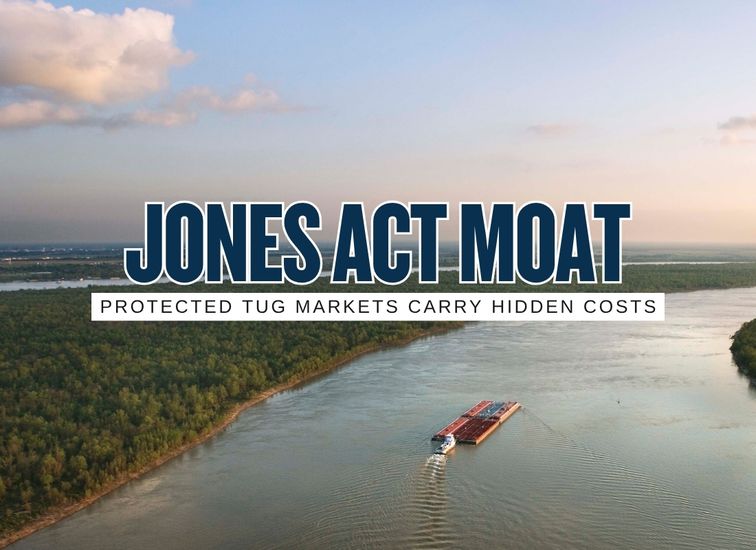
The Jones Act is both a moat and a wall for U.S. tug and barge operators. At its core, the law limits the transportation of merchandise between U.S. coastwise points to vessels that are U.S.-owned and properly documented with a coastwise endorsement, with the U.S.-build requirement central to coastwise eligibility. MARAD summarizes the rule as requiring U.S.-built, U.S.-owned and Coast Guard coastwise-endorsed vessels for domestic waterborne merchandise moves, while CBP’s 2024 Jones Act informed-compliance publication notes that coastwise points can include points within a harbor. For tug and barge companies, that creates a protected domestic market, but also a higher-cost operating environment where vessel availability, shipyard capacity, crew supply, compliance planning and cargo routing all matter.
The Jones Act creates a domestic tug and barge moat with real operating costs
For tug and barge companies, the Jones Act can be a market shield, a compliance trap, a pricing support and a growth limit at the same time. The same law that protects domestic operators from foreign-vessel competition can also raise vessel costs, narrow fleet choices and make project planning more complicated.
U.S.C. § 55102 is the core coastwise merchandise law commonly discussed as the Jones Act in domestic cargo movements.
The American Waterways Operators describes the tugboat, towboat and barge industry as the largest segment of America’s Jones Act fleet of 40,000 vessels.
AWO says the domestic maritime industry supports 650,000 American jobs and $154 billion in economic output.
The practical gate for many operators is vessel eligibility, cargo movement structure and documentation clarity.
The short commercial read
The Jones Act is an opportunity for operators already inside the U.S. coastwise system. It is a barrier for foreign-built vessel owners, non-U.S. operators, shippers seeking the cheapest possible domestic water move and project developers that need specialized marine assets not readily available in the compliant fleet.
Sources: MARAD domestic shipping, CBP Jones Act informed compliance, 46 U.S.C. § 55102, GAO domestic oceangoing shipping, American Waterways Operators.
Opportunity or barrier depends on the operator’s position
The Jones Act does not affect every tug and barge company the same way. A compliant operator with the right vessels in the right region may benefit from protected demand, repeat cargo, high switching friction and a customer base that cannot simply call in foreign tonnage. A project developer, foreign owner or shipper with unusual cargo may experience the same law as a constraint that limits vessel options and raises total delivered cost.
That is why the law is best viewed as a gate system. It filters which vessels can carry merchandise between U.S. coastwise points, who can compete for certain domestic cargo moves and how projects must be structured. Tug and barge companies that understand the gate can use it strategically. Companies that treat it as a simple slogan can walk into expensive mistakes.
9 decision gates for tug and barge operators
① Coastwise eligibility creates a domestic moat
A tug and barge operator that controls compliant tonnage has something valuable: access to domestic cargo movements that foreign-built or non-coastwise-qualified vessels generally cannot perform. That protection can stabilize demand in trades such as petroleum products, aggregates, construction materials, project cargo, inland river freight, coastal barge work and harbor support.
The moat is strongest when the work requires local knowledge, terminal relationships, recurring schedules, crew availability and specialized equipment. In those cases, the Jones Act does more than restrict competition. It reinforces the value of an established domestic operating platform.
② U.S.-built tonnage can be expensive and scarce
The protection comes with a cost. A compliant vessel usually has to fit the U.S.-build and documentation pathway. That can make fleet expansion more expensive than sourcing foreign-built equipment, especially for specialized barges, ATB units, heavy-lift assets, marine construction equipment or newer low-emission vessels.
For operators, this can support asset values. For shippers and project developers, it can feel like a capacity squeeze. The commercial tension is that the same rule that protects existing domestic tonnage can make new capacity slower and more expensive to create.
③ Tug and barge combinations need clean movement planning
Jones Act analysis is not just about the tug or the barge in isolation. Operators need to understand the cargo, the route, the lading point, the unlading point, whether the points are coastwise points and whether any part of the transportation involves non-qualified vessels.
This is especially important for project cargo, offshore energy work, dredging support, marine construction, repair moves, lightering, staged cargo transfers and mixed domestic-international voyages. A small planning mistake can change the legal profile of the movement.
④ Offshore wind created a new Jones Act planning market
Offshore wind has forced developers, contractors and vessel owners to design around U.S. coastwise rules. CBP rulings involving wind turbine components, offshore installation vessels, tugs, barges and the Outer Continental Shelf show how detailed the analysis can become.
That complexity can be a barrier for foreign installation vessels and project developers. It can also be an opportunity for Jones Act-qualified barges, feeder services, tugs, port staging, cable support, crew transfer, anchor handling and marine logistics companies that can fit into the compliant project structure.
⑤ Inland operators benefit from a different cost equation
Inland towing and barge operations are not the same as U.S. oceangoing liner trades. Inland operators often compete with rail and truck, move bulk cargo at scale and rely on networks of rivers, locks, fleeting areas, terminals and industrial customers.
In that environment, the Jones Act can support a large domestic tug, towboat and barge ecosystem while still requiring operators to stay cost competitive against land transport. The opportunity is recurring domestic freight. The barrier is that waterborne service must still win on reliability, terminal access and total delivered cost.
⑥ Island and noncontiguous trades remain politically sensitive
Domestic oceangoing trades to places such as Alaska, Hawaii, Guam and Puerto Rico are often at the center of Jones Act debate. GAO has described these as discrete shipping markets, with most cargo transported by a few carriers in each market.
For tug and barge operators, these trades can create valuable protected routes. For shippers and public officials, concentrated service options can raise questions about rates, resiliency, emergency response and whether the market has enough capacity during disruptions.
⑦ Waiver talk creates uncertainty even when waivers are rare
Jones Act waivers are often discussed during emergencies, fuel disruptions, storms or national-security events. Even when a waiver is temporary or narrow, the conversation can affect commercial expectations. Shippers may ask whether cheaper foreign tonnage could be allowed. Domestic operators may worry about precedent.
Tug and barge companies should not build strategy around waiver speculation, but they should be ready to explain their role in resilience, domestic capacity and emergency response. That story matters when the law becomes part of a public debate.
⑧ Compliance knowledge becomes a sales advantage
Many customers do not understand coastwise rules in enough detail to structure a complex marine move. A tug and barge operator that can identify compliance issues early can protect the customer from delays, penalties, rerouting and contract disputes.
This creates a valuable advisory role. The operator is not just selling horsepower and barge space. It is selling route clarity, vessel eligibility, documentation discipline and practical knowledge of how domestic marine logistics actually works.
⑨ Decarbonization could widen the divide
Cleaner tugs, hybrid vessels, battery systems, alternative fuels and lower-emission barging can make compliant domestic fleets more attractive to ports, terminals and cargo owners. But if U.S.-built low-emission vessels cost substantially more or take longer to build, the Jones Act fleet could face a more expensive transition than competitors in open international markets.
That makes fleet strategy critical. Operators that modernize early may benefit from protected access plus cleaner-service value. Operators that wait too long may face the worst combination: older vessels, higher customer pressure and limited affordable replacement options.
Operator position map
Best positioned
Compliant fleet Recurring cargo Regional relationships Strong crewingOperators with eligible vessels, experienced crews, customer relationships and specialized domestic routes can treat the Jones Act as a commercial moat. Their challenge is to maintain reliability, keep assets modern and avoid becoming complacent behind the legal shield.
Most constrained
Foreign-built assets Specialized project cargo Tight schedule Limited U.S. tonnageDevelopers or operators that need specialized assets may experience the law as a barrier if compliant vessels are scarce, expensive or technically mismatched to the job.
Highest advisory value
Offshore wind Dredging support Marine construction Heavy cargoComplex projects create space for tug and barge companies that can help customers structure compliant logistics, identify risk points and coordinate with counsel when a ruling or formal legal review is appropriate.
Future pressure zone
Hybrid tugs Low-emission barges Port clean-air plans Capital costDecarbonization may make compliant clean fleets more valuable, but it can also sharpen the cost challenge if U.S.-built cleaner vessels are expensive or delivery slots are limited.
Jones Act opportunity or barrier checker
This simple planning tool estimates whether the Jones Act is more likely to support or constrain a tug and barge opportunity. It is not legal advice. Complex movements should be reviewed with qualified maritime counsel or through the appropriate ruling process.
Commercial checklist before quoting a Jones Act-sensitive move
Strategic read for tug and barge owners
The Jones Act is strongest as a business advantage when operators combine compliant assets with customer education, route discipline, crewing reliability and a modern fleet plan. It becomes weaker when companies rely on legal protection alone while ignoring vessel age, cost, emissions pressure, project complexity and customer frustration. The winners are likely to be the operators that treat compliance as one part of a broader service advantage.