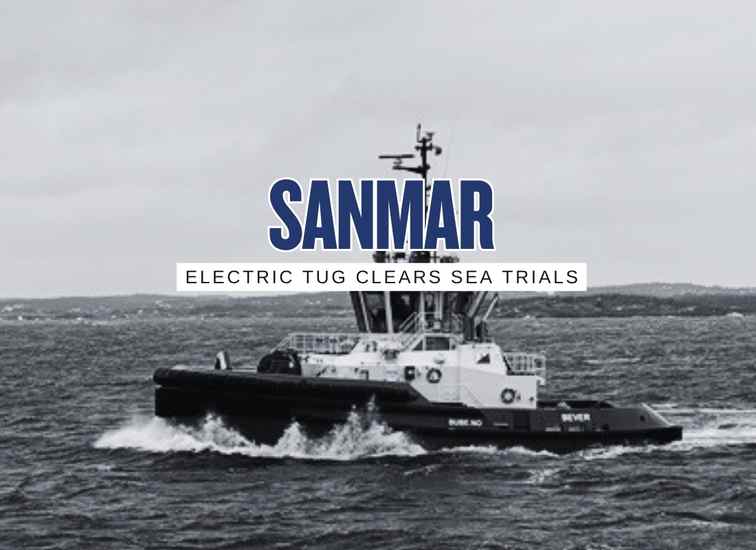
Sanmar said in early April 2026 that it had successfully completed sea trials for DINAMO IV, its 14th fully electric tugboat, during the company’s 50th anniversary year. The vessel is an ElectRA 2500SX design developed with Robert Allan Ltd., and multiple trade reports describing the trials say it carries 1,808 kWh of battery capacity, delivers 70 tonnes of bollard pull, reaches 12.5 knots, and includes FiFi capability and a forward ship-handling winch. That follows Sanmar’s earlier published pipeline showing 7 ElectRA tugs delivered by end-2024 and 6 more expected in 2025, while Sanmar’s 2024 sustainability report also gives a useful real-world operating reference from its own Dinamo 2023 electric tug at İzmit Port, which performed 845 maneuvers in 181 days and completed 72% of those maneuvers on shore-charged battery power alone.
Sea trials push Sanmar’s battery tug count to 14
DINAMO IV has completed sea trials as the newest unit in Sanmar’s ElectRA series, adding another full-electric harbor tug to a pipeline that has been building across multiple operators and operating profiles. The tug arrives with a familiar headline package for this class: compact harbor dimensions, 70-tonne bollard pull, battery-electric propulsion, and a layout aimed at mainstream port-assist work rather than a niche demonstration role.
The latest vessel in a longer buildout
The immediate news is straightforward. Sanmar says DINAMO IV has completed sea trials and joins the company’s growing all-electric tug tally during its 50th anniversary year. The vessel is part of the ElectRA family, a line developed around battery-electric harbor towage rather than one-off experimental builds. That matters because the story here is not simply that one tug performed well in trials. It is that another production unit has moved through the build-and-test cycle in a segment that is starting to develop a repeatable industrial pattern.
The vessel’s reported specification keeps it squarely in the serious harbor-assist category. At roughly 25.4 meters in length with 70 tonnes of bollard pull, it is not being presented as a compromise tug built to satisfy an emissions narrative. The package suggests a design intended for real commercial shifts in conventional port service, provided the local charging setup and duty cycle fit the tug’s operational profile.
The vessel behind the headline
DINAMO IV sits in a practical part of the electric tug conversation. It is large enough to be taken seriously by mainstream harbor operators, yet compact enough to be directed toward repetitive berth-assist work where battery-electric propulsion can actually match the pattern of service. The tug’s published figures point to a vessel designed for port duty cycles that reward high torque, repeat maneuvers, and recharge opportunities between working windows rather than long unsupported transits.
| Item | Reported detail | Importance in harbor service |
|---|---|---|
| Vessel name | DINAMO IV | Places the sea-trials update within Sanmar’s broader ElectRA delivery line rather than as a concept vessel. |
| Design | ElectRA 2500SX | Signals a known battery-electric harbor tug platform instead of a bespoke demonstration one-off. |
| Length overall | 25.40 m | Fits a compact but serious harbor-assist envelope, balancing maneuverability with working capability. |
| Beam | 12.86 m | Supports tug stability and working posture during assist operations. |
| Maximum draft | 5.40 m | Relevant for deployment flexibility across terminals and port restrictions. |
| Battery capacity | 1,808 kWh | Defines the operating envelope for daily maneuvers, recharge planning, and reserve strategy. |
| Bollard pull | 70 tonnes | Keeps the tug in a commercially meaningful assist bracket, not a reduced-power green niche. |
| Top speed | 12.5 knots | Important for response time and local positioning between harbor jobs. |
| Additional equipment | FiFi class system and forward ship-handling winch | Shows the tug is configured for full service usefulness, not only zero-emission propulsion optics. |
Why this particular milestone feels more substantial
The most interesting part of this story is not the trial itself. Sea trials are expected. The more important signal is that the company’s electric buildout has moved well beyond a first or second delivery phase. By late 2025 Sanmar had already publicized additional deliveries and an expanding orderbook around operators in different markets. Crossing the 14-tug mark makes the industrial pattern harder to dismiss as a narrow pilot trend.
That does not mean every port is ready for full-electric towage. It does mean the conversation is shifting from “can this be built?” to “which port profiles and charging setups make the economics and uptime work best?”
The operating profile is still the real gatekeeper
- Electric harbor tugs are strongest when maneuver patterns are repetitive and charging is available between duty windows.
- Battery capacity alone does not tell the whole story because energy draw changes sharply with the intensity of each assist.
- Port layout, standby expectations, transit distance, and back-to-back job clustering can all change the practical fit.
- A tug that looks ideal on paper can still be constrained if the shore-power side of the operation is not equally mature.
A useful real-world reference point
Sanmar’s own 2024 sustainability reporting offers a helpful operational benchmark from another ElectRA tug, Dinamo 2023, working at İzmit Port. That vessel completed 845 maneuvers across 181 active days in 2024. The same report says 72% of those maneuvers were completed entirely on shore-charged battery power, while 28% used support from the range extender due to limited charging time or unexpected back-to-back operational demand. The implication is not that every ElectRA tug will post the same numbers. It is that utilization and charging logistics matter just as much as the battery headline figure.
Electric tug duty-fit estimator
This tool uses Sanmar-style operating concepts for a 1,808 kWh electric harbor tug to test whether a planned duty day looks light, workable, or charging-constrained. It is a simplified planning aid, not a class-approved operating model, but it gives readers a useful feel for how quickly harbor energy demand can move depending on maneuver intensity and recharge time.
This shift profile looks realistic for a 1,808 kWh electric harbor tug with moderate recharge opportunity and a sensible reserve target still intact.