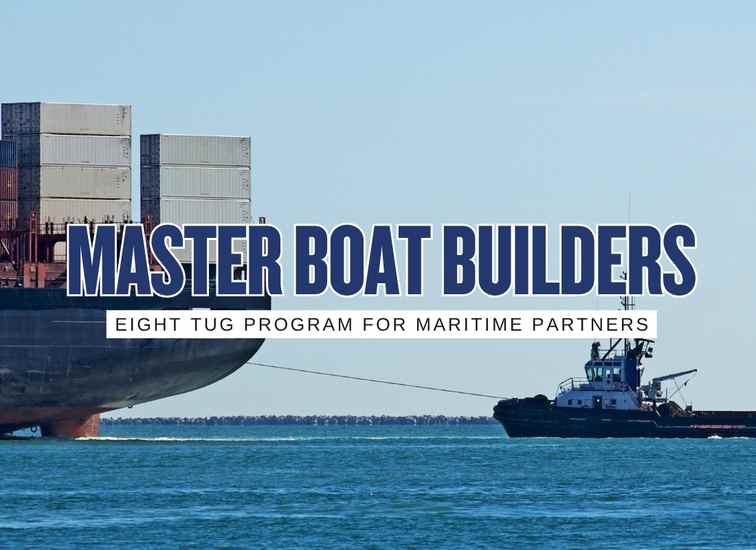
Master Boat Builders has launched Marauder, the first tug in an eight-vessel series being built in Coden, Alabama, for Maritime Partners, with delivery targeted for early May. The program is set up on a steady production rhythm, with the yard expecting to turn out roughly one tug about every six weeks through 2027. The first vessel is being presented as a ship-assist and escort tug designed to work across a wide range of port assignments rather than a narrow single-mission profile, and the package includes firefighting capability, Tier 4-compliant propulsion, and outfitting choices that let the series be tuned for different operational priorities.
A new eight tug buildout moves from contract talk to steel-and-water reality
The launch of the first Maritime Partners tug at Master Boat Builders turns an announced fleet program into a visible production story. Instead of a single showcase boat, this is the front end of a repeat-build sequence that is expected to continue through 2027, giving the market a clearer look at how owners, leasing platforms, designers, and Gulf Coast yards are trying to line up modern escort and ship-assist capability on a predictable schedule.
Launch milestone and the vessel behind it
The first vessel in the series, Marauder, is being positioned as a modern harbor tug with escort capability built into the design rather than added as an afterthought. That matters because it points to a tug intended to move between demanding ship-assist work and more structured escort assignments without forcing the owner into a highly specialized, narrow-use platform.
In practical terms, that gives the program a wider commercial footprint. A tug that can handle larger-port escort requirements while still remaining comfortable in day-to-day harbor service is easier to place across varied operating environments, and that flexibility is one of the clearest themes coming through the published details around the build.
The first launch matters because the real commercial story is repetition. Serial tug construction lets the yard sharpen production rhythm, gives the owner or lessor a more uniform fleet profile, and makes the order book easier for the market to read.
The tug profile being described points to a vessel meant to cover ship-assist, escort, and marine support work in a way that broadens deployment options instead of locking the asset into one tightly defined role.
For Master Boat Builders, this launch is another sign that the yard is working well beyond boutique output and into a steadier production role in the U.S. tug market.
Key facts shaping the early read
| Item | Current reported detail |
|---|---|
| Series size | Eight tugs in the Maritime Partners program |
| First vessel | Marauder |
| Build yard | Master Boat Builders in Coden, Alabama |
| Design family | Robert Allan Ltd. RApport 2700-MP ship-assist and escort tug |
| Delivery tempo | About one tug every six weeks through 2027 if the cadence holds |
| Power profile | 90-plus metric tons bollard pull, Tier 4 propulsion, firefighting package |
| Fleet context | Built for a maritime asset platform with broad leasing and financing reach rather than a small single-port operator footprint |
Why this tug series stands out in the current market
There are several layers to this launch. The first is straightforward vessel capability. This is not being framed as a light harbor helper. The published package points to a compact but serious ship-assist and escort tug with strong bollard pull, modern propulsion, firefighting capability, and an equipment layout that leaves room for different operating priorities. That tends to push the story above a normal yard progress update.
The second layer is program structure. Eight repeat vessels create a more important signal than one custom newbuild because repetition says something about demand confidence, capital planning, and the willingness to standardize around a known tug format. In the tug market, repeatability often means the owners or financiers believe they can place similar assets across multiple service opportunities without starting from scratch each time.
The third layer is strategic positioning. Maritime Partners is not simply a traditional tug operator adding one more unit to a local fleet. Its role as a financing and leasing platform changes the interpretation. A standardized series of modern tugs can support chartering flexibility, asset deployment across different operating partners, and a cleaner portfolio story for a business built around maritime asset ownership and placement.
Eight sister or near-sister tugs make training, maintenance planning, spares strategy, and technical documentation easier to standardize. That is not flashy, but it matters in a tug fleet where uptime and dispatch confidence carry real value.
A vessel described as capable of escort work in large ports while still handling more traditional harbor-assist duties points to an asset that may appeal across a wider spread of end uses. That makes sense for an owner with a portfolio mindset.
Master Boat Builders has been scaling its tug presence, and this series reinforces the idea that Gulf Coast yards with repeat commercial work and proven naval architecture partners can still carve out meaningful production niches in a demanding domestic market.
Program pressure points to watch next
The six-week cadence is one of the most important pieces of the whole story. If it holds, the program starts to look less like a news item and more like a sustained industrial schedule.
Another question is whether these tugs are destined for clearly defined operating homes early or whether they support a more flexible placement model. That distinction changes the commercial interpretation of the order.
Standardization usually helps series construction, but end-user needs can still push equipment choices around winches, firefighting packages, and assignment profile. Watching how tightly the vessels stay aligned will say a lot about the program strategy.
A sharper industry reading
The launch of Marauder shows the market three things at once. Modern U.S. tug construction is still moving through repeat-build programs, not only isolated custom jobs. Asset platforms are still willing to back useful, broadly deployable tug designs. And yards that can combine schedule discipline with strong partner networks remain well positioned to win more than ceremonial attention when the first hull hits the water.
Eight Tug Delivery Tracker
This tool turns the published cadence into a visual schedule estimate. It starts from the reported early-May delivery target for the first tug and then rolls forward at roughly six-week intervals to map the rest of the series.
The launch of the first tug in this Maritime Partners series gives the market something more useful than a simple yard photo opportunity. It provides an early look at a repeat-build tug program that combines modern ship-assist and escort capability with an asset-platform ownership model and a visible production cadence. As more vessels move through the schedule, the story will be less about the novelty of the first launch and more about whether the program keeps its rhythm and translates that design philosophy into a recognizable fleet profile.