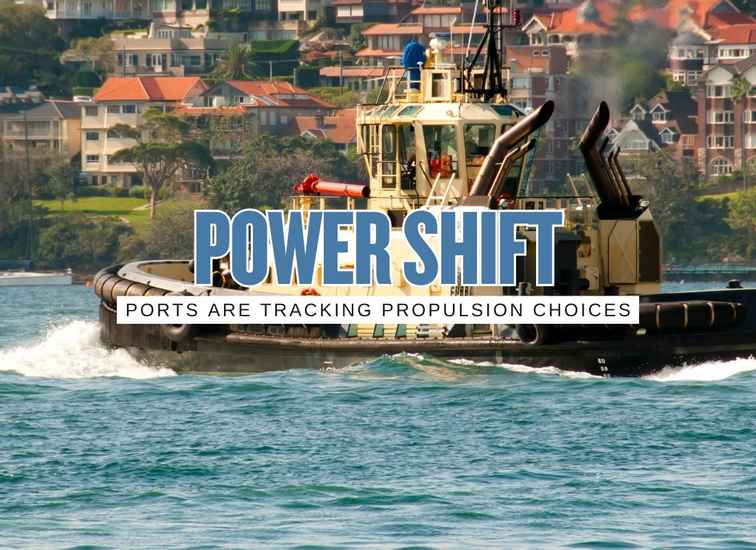
Ports are watching tug propulsion more closely in 2026 because the decision is no longer just about engines and bollard pull. It now sits at the intersection of port decarbonization targets, fuel and charging availability, tender competitiveness, local air-quality pressure, duty-cycle fit, and the wider regulatory signal coming from FuelEU Maritime and the IMO’s approved net-zero framework measures. At the same time, the tug market is producing real examples instead of only concepts, including battery-electric tugs, hybrid-electric fleets, methanol-ready and methanol-fuelled tugs, LNG dual-fuel operations, hydrogen pilots, ammonia demonstrations, and growing interest in drop-in biofuels as a near-term bridge. That mix is why ports are not watching one propulsion future. They are watching several at once.
2️⃣ Diesel-electric
3️⃣ Hybrid-electric diesel battery
4️⃣ Shore-charged battery-electric
5️⃣ Methanol-ready hybrid systems
6️⃣ Methanol dual-fuel propulsion
7️⃣ LNG dual-fuel propulsion
8️⃣ HVO and advanced biofuel drop-in pathways
9️⃣ Hydrogen-electric and fuel-cell based systems
🔟 Ammonia-based propulsion concepts
It is easy to overlook conventional diesel because it is familiar, but ports are still watching it closely as the baseline against which every alternative is being judged. Many tug operators still need immediate capacity, proven flexibility, and straightforward maintenance across variable assignments. That keeps high-efficiency diesel designs relevant, especially where infrastructure for alternative energy remains limited.
The issue is not that diesel is suddenly technically weak. It is that its long-term regulatory and commercial story is getting harder to defend in ports with stronger decarbonization pressure.
Ports are also watching diesel-electric because it offers a more refined power-management story without forcing a full fuel change. Tug work is full of varying loads, bursts of high demand, and long periods below peak power. Diesel-electric systems can manage that pattern more efficiently than simpler conventional arrangements in some operating profiles.
For ports that want measurable efficiency improvement but are not yet ready to build out new fuel or charging systems, diesel-electric can still look like a credible transitional choice.
Battery-electric tug propulsion has moved far enough beyond concept that ports now have to evaluate it seriously rather than symbolically. The core attraction is obvious: zero direct emissions during harbor operations when charged from clean electricity, plus lower noise and potentially lower maintenance in the right profile.
The catch is equally clear. Battery-electric only works well when a port’s tug assignments, return-to-base rhythm, shore power planning, and energy reliability all line up. That makes it highly attractive in some ports and a poor fit in others.
One path ports are watching closely is the methanol-ready hybrid concept. This is attractive because it lets an operator improve efficiency and lower emissions through hybridization now while keeping open the possibility of shifting toward methanol later if supply, pricing, safety confidence, and port infrastructure improve.
That future-proofing logic is powerful in 2026 because many ports know they want cleaner tug operations but still do not want to lock themselves too early into one future-fuel outcome.
Methanol has become one of the most watched tug fuel stories of 2026 because it is now linked to actual towage delivery schedules and operations rather than distant theory. That matters for ports because methanol sits in the sweet spot between being more ambitious than a simple drop-in fuel and more practically discussed than some frontier fuels.
Ports watching methanol are asking whether it can become a credible alternative-fuel ecosystem around terminals, coastal energy infrastructure, and low-emission marine services. The presence of real methanol tug programs is making that question much harder to postpone.
LNG dual-fuel tug propulsion no longer feels like the newest story, but ports are still watching it because it remains one of the more established lower-emission alternatives in certain marine clusters. Where LNG bunkering capability, terminal familiarity, and trained personnel already exist, LNG can look more operationally grounded than fuels that remain mostly strategic conversation.
The challenge is that some ports now see LNG more as a transitional or regional solution than as the final long-term answer, especially as other propulsion paths gather momentum.
Hydrogen-electric tug propulsion is still an early-stage path in commercial terms, but ports are watching it because it represents a much more radical zero-emission option and because real pilots and first-of-kind projects continue to appear. That makes it strategically important even where immediate deployment is limited.
In 2026, ports are mostly studying hydrogen less as a mass solution for today and more as a signal about which energy ecosystems may matter later in the decade.
Ammonia remains one of the most challenging propulsion paths, but ports are watching it because it carries large decarbonization potential and has moved beyond abstract debate. Ammonia-based vessel projects and tug demonstrations have made it clear that the marine sector takes the fuel seriously.
Ports are not generally treating ammonia as the easiest tug answer for 2026. They are treating it as one of the fuels most likely to shape future-fuel strategy, terminal planning, and safety thinking over a longer horizon.
This quick tool estimates which propulsion direction a port environment may favor most strongly right now. It is a planning aid, not a formal engineering model.